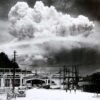
On Aug. 9, 1945, as Japan’s high command met on surrender plans, the U.S. dropped a second bomb on Nagasaki killing 74,000 people instantly, a decision that’s never been adequately explained, writes John LaForge.

On Aug. 9, 1945, as Japan’s high command met on surrender plans, the U.S. dropped a second bomb on Nagasaki killing 74,000 people instantly, a decision that’s never been adequately explained, writes John LaForge.

An all-Christian American crew used the steeple of Japan’s most prominent Christian church as the target for an act of unspeakable barbarism, writes Gary G. Kohls.

Hiroshima and Nagasaki were acts of premeditated mass murder unleashing a weapon of intrinsic criminality. It was justified by lies that form the bedrock of 21st century U.S. war propaganda, casting a new enemy, and target — China.

The first atomic bomb burst at 8:15 a.m. over the city of Hiroshima leaving its impression on a watch that disappeared 44 years later, reports Joe Lauria.
In this introduction to the memoir of a Nagasaki bombing victim, historian Peter Kuznick shows why the bombs were dropped and how some victims’ anger propelled the Japanese anti-nuclear movement.

After the U.S. atomic bombings of Hiroshima and Nagasaki On Aug. 6 and Aug. 9, 1945, there then ensued a U.S. propaganda campaign to claim the slaughter of more than 200,000 people saved lives, writes John LaForge.

Trump is looking for ways to save money — an excellent idea given that the U.S. federal budget is hemorrhaging $2 trillion a year. Here’s where to start.

The multipolar world will be born when the geopolitical weight of Asia, Africa, and Latin America matches their rising economic weight.

Literacy gives us the power to build a collective life — it allows us to see our history with clarity, be critical of our present and demand the impossible of the future.

Hundreds of millions of people from the Americas to China have been killed or subdued so a small part of the world — the North Atlantic — could enrich itself. That is madness.