Serbia’s new authorities have to decide whether to preserve their foreign-policy independence or submit to the dictates of the Brussels bureaucracy in order to gain E.U. admission, writes Uroš Lipušcek.
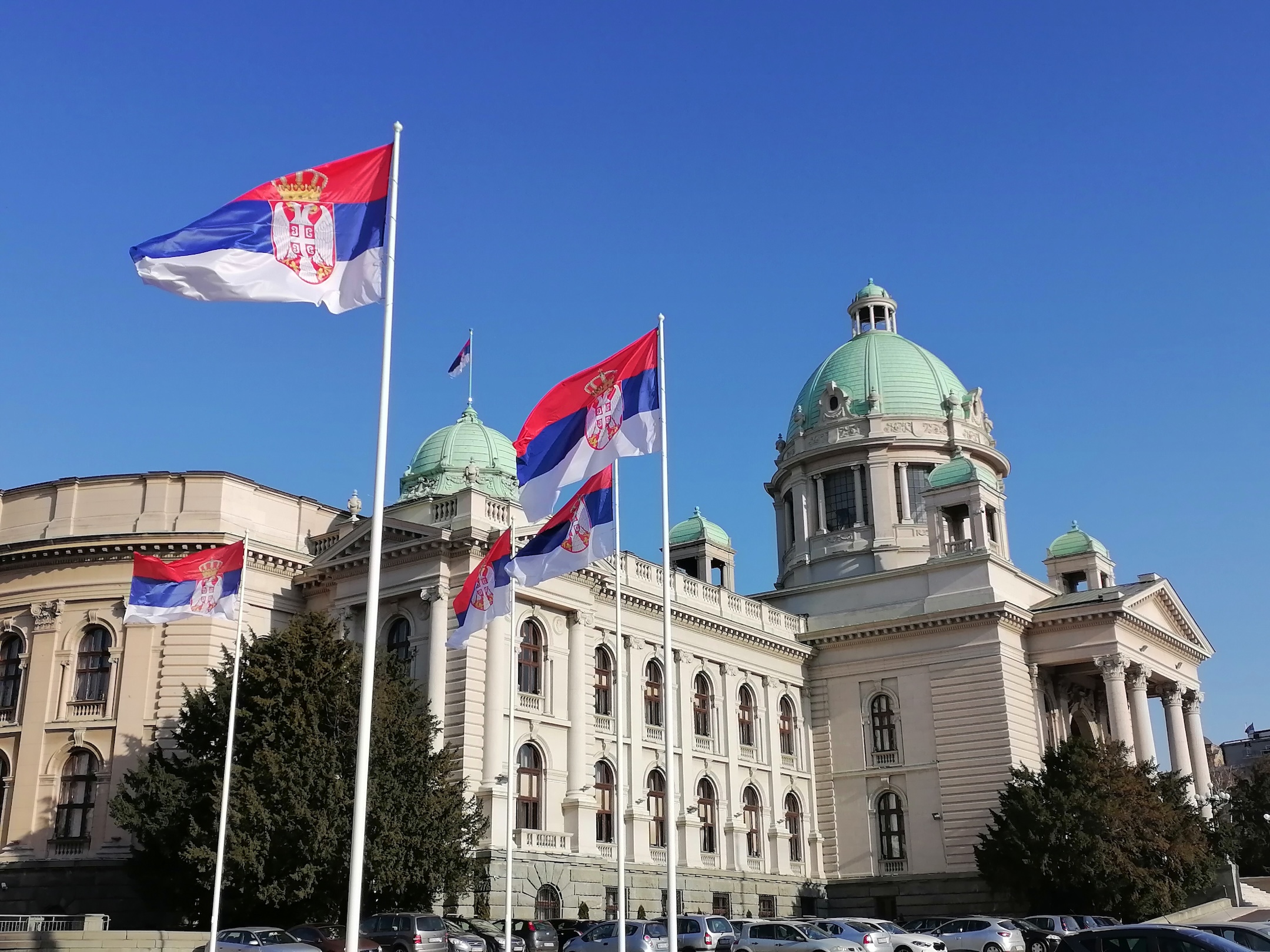
Serbia’s Parliament building in Belgrade. (Andrija12345678/ Wikimedia Commons/CC BY-SA 4.0)
By Uroš Lipušcek
in Ljubljana, Slovenia
Special to Consortium News
 In the context of the Europe-wide protests, Serbia is a sui generis case because of its military neutrality, its geopolitical position and its attempts to balance relations with the E.U., the United States, Russia and China.
Following the break-up of Yugoslavia and the fall of Slobodan Miloševic’s regime three decades ago, successive Serbian governments pursued a foreign policy with distinctly Serbian characteristics. They simultaneously pursued a pro-European foreign policy and a policy of neutrality, or military non-alignment, incompatible with the E.U.’s sanctions on Russia and its increasingly confrontational approach to China.
The immediate trigger for the mass protests in Serbia, which resulted in the defeat last Saturday of the long-standing rule of Aleksandar Vucic, leader of the Serbian Progressive Party, was the tragedy of Nov. 1, 2024, when a canopy at the railway station in Novi Sad collapsed, killing 16 people.
The disaster raised questions about accountability, corruption, the quality of public investment and the functioning of state institutions. All this provided sufficient grounds for the protests’ emergence.
The student movement initially demanded the publication of documentation relating to the station’s renovation, an investigation into responsibility and the prosecution of those accountable. The protests gradually spread throughout the country. Students were joined by professors, teachers, farmers, workers and other sections of the population. The movement developed into the most serious political challenge to Vucic’s government.
An important characteristic of the Serbian student movement was its decentralised organisation. The students avoided traditional political hierarchies and relied on social networks and local organisation. Interestingly, striking students during the protests in Hong Kong had established a similar organisation to prevent Chinese authorities from identifying leaders of the demonstrations.

A ZLF, or Green–Left Front Party, sign with the red handprint symbol of the Serbian protests that began after the collapse of the Novi Sad railway station. The sign reads: “Your hands are bloody,” which become a slogan of the 2024-2025 anti-corruption movement. (SergioOren / Wikimedia Commons/ CC0)
Since Western intelligence services were allegedly involved in the Hong Kong unrest, unconfirmed suggestions emerged that the Serbian movement might be a copy of the Hong Kong model of uprising. These suspicions were reinforced by reports that Serbian non-governmental organisations operating in the fields of human rights, election monitoring, the media and democratic institutions had received funding from relevant U.S. and European programmes.
Among the important donors were USAID and the National Endowment for Democracy (NED), as well as European foundations and other international funding organisations. The Serbian authorities repeatedly accused the protesters of preparing a colour revolution.
After almost two years of protests, the movement contested the early parliamentary elections held on Oct. 25 this year. The student electoral list received 53.01 percent of the vote, securing 139 of the 250 seats in Parliament, while Vucic’s electoral list received 38.98 percent of all votes.
The parliamentary elections brought an end to Vucic’s 14-year rule. He has announced that he intends to return to power in two years. For the time being, it remains unclear what domestic and, above all, foreign policy the new government will pursue. Its composition is not yet known.
Vucic’s Balancing Effort at Foreign Policy

Vucic, on right, with then-European Commission Vice-President Josep Borrell at the Munich Security Conference in February 2024. (European Union/Flickr/ CC BY 4.0)
The roots of the student unrest in Serbia, which lasted almost two years, were undoubtedly domestic. Vucic had established a highly authoritarian system of government, similar to that of former Prime Minster Viktor Orbán in Hungary, and had brought the leading media almost entirely under his control.
To date, nobody has been punished for the collapse of the canopy at the Novi Sad railway station, which students regard as evidence of widespread corruption. The fight against corruption is expected to be one of the new government’s central priorities.
Vucic pursued a foreign policy that sought to navigate between the mythical Greek sea monsters Scylla and Charybdis, attempting to maintain a balance in relations with the E.U., the United States, Russia and China.
Ultimately, his strategy failed, primarily because Brussels increasingly exerted ultimatum-like pressure on him to sever relations with Russia and impose sanctions on Moscow. It’s no coincidence that the highest representatives of the E.U. greeted his electoral defeat with enthusiasm.
Berlin also applauded, hoping that the new government would agree to Serbia becoming a supplier of strategically important lithium for the German automotive industry.
For the time being, conflicting statements are emerging from Belgrade regarding the new government’s strategic orientation. Some suggest that it will impose sanctions against Russia, while others promise that Serbia will preserve its strategic neutrality. The latter could mean that Serbia’s accession to the E.U. would ultimately be abandoned.
Serbia is particularly interesting in this context. Back in 2007, it declared military neutrality, a policy that Vucic maintained despite increasingly strong pressure over Serbia’s relations with Russia and NATO, with which the Serbian armed forces nevertheless cooperate within the framework of the Partnership for Peace programme.
The 2014 coup against Ukrainian President Viktor Yanukovych, who had advocated a neutral Ukraine, demonstrated that the West was unwilling to tolerate a non-aligned or neutral Ukraine.
The question now facing Serbia’s new authorities is whether they will be able to preserve their right to make independent decisions on domestic and foreign policy, or whether, if Serbia wishes to be admitted to the E.U., it will have to submit entirely to the dictates of the Brussels bureaucracy.
The Ukrainian tragedy has demonstrated just how dangerous geopolitical competition can be for a small country that becomes an arena for confrontation and rivalry between major powers.
Uroš Lipušcek Ph.D. is a Slovenian journalist and historian who was the long-time correspondent for RTV Slovenija from the U.N., U.S. and China. He was a candidate for the E.U. parliament in 2024. At present he is a professor at Emuni University (Euro-Mediterranean University) in Piran, Slovenia. He is the author of several books and analyses on history, among them Ave Wilson: USA and the Remaking of Slovenia in Versailles 1919–1920, (2003) and Sacro Egoismo: Slovenians in the Clutches of the Secret London Pact of 1915 (2012).
The views expressed are solely those of the author and may or may not reflect those of Consortium News.
Actually the student movement was preceded by mass protests against the mentioned lithium mine. The mining project envisioned storing toxic waste next to some of the cleanest rivers in Europe and mining royalties that are amongst the lowest in the world. It was an obvious colonial extraction scheme that would benefit only the German and EU automotive industry. Vucic was all for it and in return, it seems, he got protection from EU criticism. I think Germany is welcoming the students’ victory because they have no choice, but it seems they can say aufwiedersehen to the lithium.
The student movement has not only dethroned the Vucic regime but also kicked out the opposition politicians whose incompetence and corruption helped keep Vucic in place for 14 years even if he lost the majority of voters. I think the students’ biggest success was waking the people up to the idea that they themselves need to protect their interests and not expect any politician to do it. This victory proved that it is possible, and hopefully it will give some ideas to other protesters worldwide.
There is still a lot of work to be done, Vucic’s cronies now sit on millions of euros they got through corruption schemes. But the Serbs have learned this lesson: twenty-odd years ago, they got rid of Slobodan Milosevic in a similar way but the politicians that took over didn’t try too hard to get rid of his oligarchs and instead got in on the corruption scheme themselves. This time the public consensus is that the work has just begun.
This government will supposedly finally represent the people. The EU has bombarded the Serbs a couple of decades ago, and depicted them as the worst people on the planet so that they take the blame for the breakup of Yugoslavia, which was orchestrated by Germany and the US. This granted Germany control over Serbia, which is what they wished for for more than a hundred years. Meanwhile, Russia has remained a friend, at least by virtue of not being an enemy. So if the EU proposes an either-or choice to the Serbs, I’m not sure it will receive a positive response.
Serbia would be wise to avoid becoming part of the increasingly fascist EU.