
With corporate spending on U.S. elections soaring since an infamous 2010 Supreme Court ruling, Brett Wilkins reports on a constitutional effort to close the floodgates and a state initiative in Montana.
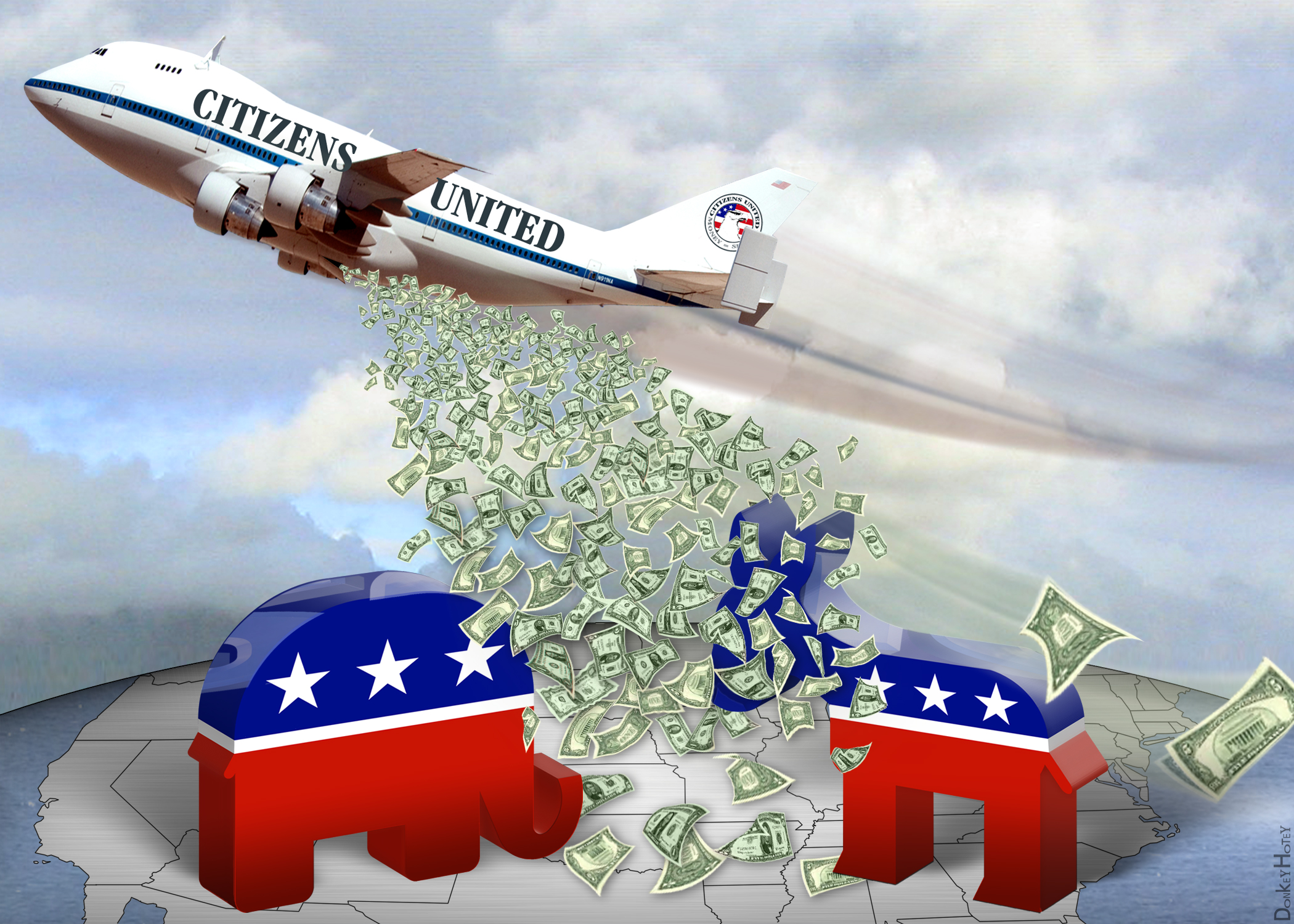
Citizens United. (Donkey Hotey / Flickr / CC BY-SA 2.0)
By Brett Wilkins
Common Dreams
 Data published last week by a leading consumer watchdog group revealed that corporate spending on U.S. elections has soared by more than 5,000 percent since an infamous 2010 Supreme Court ruling that opened the floodgates of outside political contributions — a staggering increase that critics said underscored the need for major campaign finance reform.
Public Citizen released an analysis of newly filed federal campaign finance data showing that corporate political spending has grown exponentially since the 2010 midterm election cycle, the first of the Citizens United era.
Citizens United v. Federal Election Commission affirmed corporate personhood and that unlimited political spending by corporations, nonprofit organizations, labor unions and other groups is a form of free speech protected by the First Amendment that the government cannot restrict.
The decision ushered in the era of super political action committees (PACs) — which can raise unlimited amounts of money to spend on campaigns — and secret spending on elections with so-called “dark money.”
According to the data studied by Public Citizen, corporate spending totaled $12.8 million for the 2010 election cycle. By the 2012 cycle, it had surged to $84.9 million. During the 2016 cycle, it spiked to $117.9 million.
NEW from @publiccitizen.bsky.social:
Corporate money in the 2026 midterms has reached an unprecedented $737 million, October filings show.
Full report: www.citizen.org/article/corp…
— Rick Claypool (@rickclaypool.bsky.social) October 29, 2026 at 11:55 AM
For 2026, spending this cycle — over $737 million — accounts for “40% of the $1.8 billion corporations have spent on federal elections” since 2010, Public Citizen said.
“Cryptocurrency, online betting, and Big-Tech interests — including companies involved in artificial intelligence and data centers—have collectively contributed $391 million toward the 2026 elections,” the group noted. “This accounts for more than half of corporate political spending reported this cycle.”
The analysis shows that the 50 largest donors and organizations had collectively contributed $2.77 billion, with Republican-aligned contributors accounting for roughly 60 percent of that amount.
Elon Musk — the world’s richest person and first trillionaire in history — led the pack, giving over $445 million to conservative candidates and causes. This, after the tech titan and former de facto head of the short-lived Department of Government Efficiency poured more than a quarter billion dollars into the campaign coffers of then-former President Donald Trump’s successful reelection bid and Republican congressional candidates during the 2024 cycle.

Musk in 2022. (Ministério Das Comunicações / Flickr / CC BY 2.0)
“Corporations are exploiting Citizens United to drive their political spending to unprecedented levels,” Robert Weissman, Public Citizen’s co-president, said.
“These corporations aren’t investing this money because they are civic-minded or want to advance a particular viewpoint,” he continued. “They are spending to buy influence, determine outcomes, and shape policy. This election cycle shows beyond any doubt that we desperately need a constitutional amendment to overturn Citizens United and put the people, not corporations or the super rich, back in charge of elections.”
Democrats are trying to do just that. Last year, Congresswoman Pramila Jayapal (D-WA) led more than two dozen lawmakers in introducing the We the People Amendment, a constitutional amendment that would reverse Citizens United.
The following month, Sen. Jeanne Shaheen (D-NH) led 39 upper chamber Democrats plus Sens. Bernie Sanders (I-VT) and Angus King (I-ME) in reintroducing the Democracy for All Amendment.
The proposal would allow Congress and state legislatures to impose some limits on money raised and spent to influence elections, distinguish between people and corporations and prohibit corporate election spending.
But it might not take a constitutional amendment — something that is exceedingly difficult to pass, by design — to undo Citizens United.
Montana’s State Initiative 194

Montana Capitol in Helena. (gillfoto. CC BY-SA 4.0, Wikimedia Commons)
Montana could become a testing ground for a new legal strategy to reverse the effects of the ruling without having to overturn the decision, Mother Jones reported last Thursday. Instead, Montana is challenging corporations’ legal powers under state law rather than targeting their constitutionally protected political “speech” in the form of spending.
The strategy, known as the Montana Plan, is being put to voters today on Election Day in the form of Initiative 194, which would prohibit corporations, nonprofits, labor unions, trade associations and other special interests from spending money to support or oppose candidates, political parties, or state and local ballot measures. Violators could forfeit their state-granted privileges, including limited liability.
If approved, it could provide a model for other states seeking to curb corporate political spending and anonymous campaign financing.
Other efforts include a Sanders-led push for the Democratic Party to ban super PAC and dark money spending in its primaries.
“We cannot allow billionaires and powerful corporate interests to continue undermining democracy by injecting unlimited amounts of money into the political process,” Sanders, and seven Senate backers of his proposal, asserted last year.
Brett Wilkins is a staff writer at Common Dreams.
This article is from Common Dreams.
Views expressed in this article and may or may not reflect those of Consortium News.
Paid political advertising on the public airwaves should be banned. Give each candidate on the ballot an equal block of airtime. That’s all they get. It’s on air advertising that drives up the costs of campaigns. Who benefits?
Another thing that could make money in politics moot would be to severely shorten the political season. In most countries, there’s perhaps a month’s time or less between nomination and election. And during that month, the candidates debate and actively take their message to the people. Money would lose its relevance in such a short time span, as people would focus more on actual candidate messaging.
I was part of the “Move to Amend” movement in Oregon. It got so far as to have some 16-19 states send formal request for an amendment to the constitution to congress. I didn’t hear much about it after Oregon joined the movement and also requested congress start the amendment process. Does anyone know what happened? Obviously, it didn’t go anywhere.
For more on the We The People constitutional amendment, see hxxp://movetoamend.org.
One thing to note is that labor union campaign contributions were always dwarfed by the campaign contributions emanating from the parasites of Wall Street, the multi-national corporations, and the pro-Israel sociopaths.
Labor unions are a vested interest on the side of the people. Let them spend away.
I am always fascinated how Millionaire Bernie always draws the line above himself, and below Billionaires. Billionaires are the problem, not Millionaires, according to Millionaire Bernie.
They all fall under “Tax the Rich” from my perspective down in the working class.