Under Macron’s recently announced “forward deterrence” strategy French interests assume a European dimension defined solely by France.
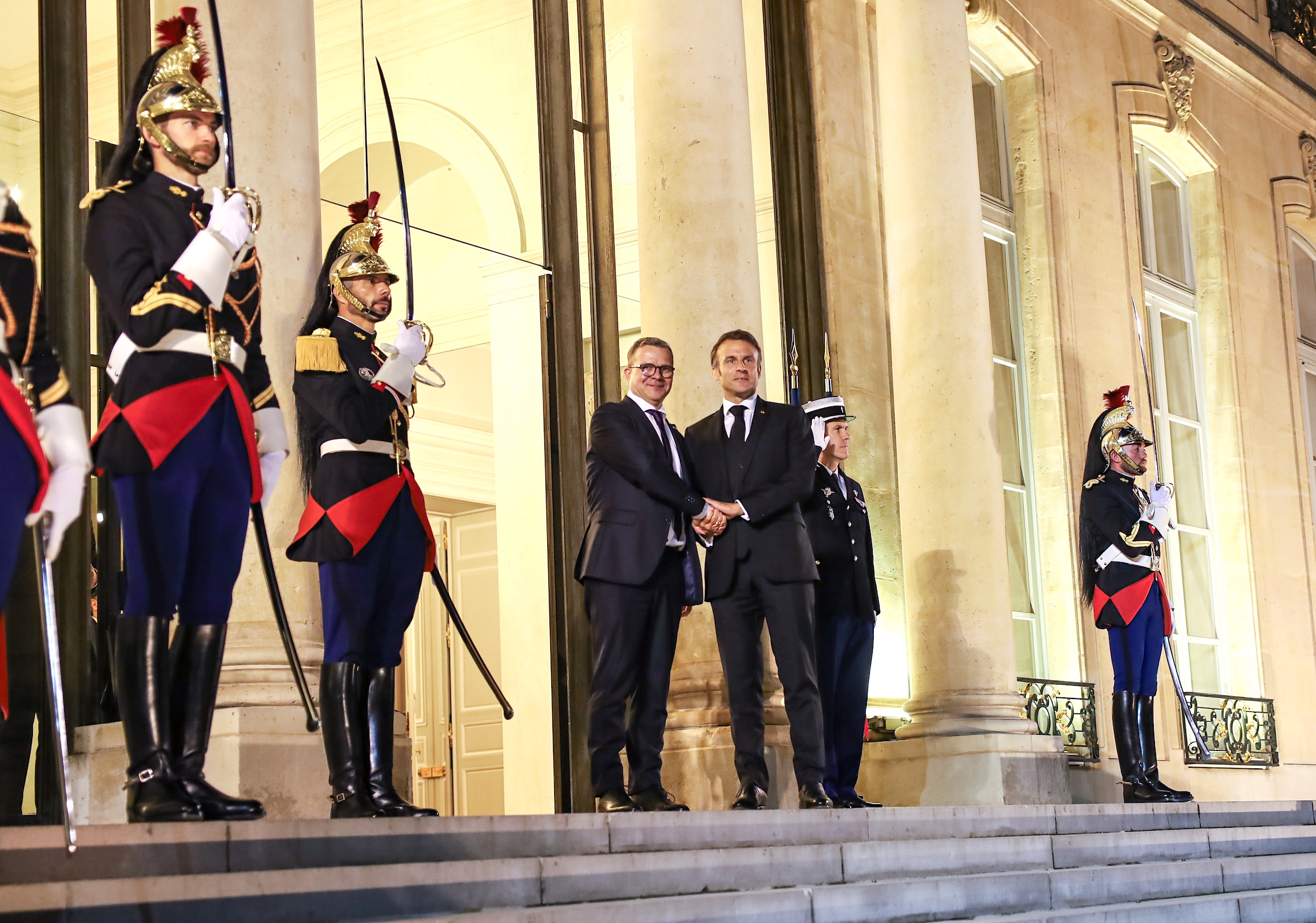
Finnish Prime Minister Petteri Orpo meeting with French President Emmanuel Macron in Paris in October 2023. (Finnish Government/ Wikimedia Commons/CC BY 2.0)
By Scott Ritter
Special to Consortium News
 Finland and France announced on Sept. 14 that they had concluded their discussions on Helsinki’s accession to the French advanced deterrence initiative, which would see nuclear-armed French Rafale aircraft operating from Finnish air bases and in Finnish skies.
This came on the heels of a June 17 vote by Finnish lawmakers to lift the country’s longstanding ban on nuclear weapons. It marked a major shift in Helsinki’s security posture as it further integrates with the force structure and policies of the North Atlantic Treaty Organization (NATO), which Finland joined in April 2023 after decades of nuclear-free neutrality.
The French-Finish bilateral cooperation will broaden the European dimension of what constitutes France’s vital interests. French nuclear doctrine, centered on the independent force de dissuasion, has long prioritized national sovereignty and existential deterrence.
Recent steps under President Emmanuel Macron have layered coordination with the United Kingdom and selective European engagement onto this foundation, without transferring decision-making authority. These expansions remain politically contested in France and face an uncertain future if Marine Le Pen and the National Rally win the presidency in the April 18, 2027, election.
French nuclear policy emerged traditionally from the Gaullist insistence on strategic autonomy after the Second World War amid Cold War dependence on the United States. Formalized in Charles de Gaulle’s 1959 École Militaire speech, the force de frappe (later force de dissuasion) was designed so France could deter a superior adversary without relying on NATO or American guarantees.
The core logic is dissuasion du faible au fort — deterrence of the weak against the strong — through the credible capacity to inflict unacceptable damage on an aggressor’s population and economy (known in the parlance of nuclear game theory as “countervalue targeting.”)
Ostensibly, the doctrine is strictly defensive: nuclear weapons protect France’s “vital interests,” a deliberately ambiguous concept, which can change over time depending on who is at the helm of the French presidency. It includes national territory and survival, but has also been interpreted by successive presidents as having a broader European dimension.
The actual use of French nuclear weapons is reserved for extreme circumstances of legitimate self-defense, although conceptually speaking, a single “ultimate warning” strike has been discussed as a possible intermediate step before broader retaliation.
France claims it does not possess first-strike nuclear potential, but rather a second-strike capability via nuclear-powered, ballistic-missile submarines (SSBNs) that ensure survivability combined with an airborne component, consisting of Rafale aircraft armed with air-launched, nuclear-tipped cruise missiles.
Under French doctrine, the French president alone decides on employment; there is no nuclear sharing, dual-key arrangements, or participation in NATO nuclear planning groups.
The principle of sufficiency has for decades kept the arsenal limited to less than 300 warheads, focused on maintaining nuclear independence rather than enhancing nuclear war-fighting or flexible nuclear response.
The maintenance of a strong French conventional military force has historically supported this posture by raising the threshold at which vital interests would be threatened. Before France would be in a position to have to consider the use of nuclear weapons, an opponent would first have to defeat the French army in battle.
France & UK Strengthen Nuclear Ties

U.K. Prime Minister Keir Starmer and Defence Secretary John Healey visiting the Permanent Joint Headquarters in Northwood in March 2025. (Simon Dawson / No 10 Downing Street/Flickr)
The foundational conceptualization of French nuclear deterrence was always somewhat of a sham — the notional concept of independence from NATO and the U.S., while existing under the actual umbrella of U.S. nuclear deterrence, premised upon a rock-solid American commitment to European security.
President Donald Trump’s second term in office, in which defense of the U.S. homeland was prioritized over everything else, changed this calculus, and France was compelled to envision a world where its nuclear deterrence posture was truly independent. When push came to shove, however, France found that a truly independent nuclear posture was not as impressive as it appeared on paper, especially when matched up against the model of a hypothetical Russian threat.
France wasn’t the only European nuclear power facing this quandary. Britain was also going through a period of nuclear existential appraisal. France and the U.K. came together to strengthen their respective nuclear postures, resulting in the July 2025 Northwood Declaration, marking a significant deepening of bilateral nuclear ties, while ostensibly preserving independence for both nations.
Signed by Macron and then-Prime Minister Keir Starmer, the Northwood Declaration reaffirmed longstanding language that the vital interests of one nation could not be threatened without those of the other also being at risk. It added that “there is no extreme threat to Europe that would not prompt a response by our two nations.” Nuclear forces remain sovereign and under national command, but “can be coordinated” and contribute to Alliance and Euro-Atlantic security.
By “extreme threat,” France and the U.K., of course, meant Russia.

A French Air Force Dassault Rafale B at the Royal International Air Tattoo airshow at the U.K.’s RAF Fairford air station in 2009. (Tim Felce/Airwolfhound/Wikimedia Commons/CC BY-SA 2.0)
A U.K.-France Nuclear Steering Group, led by the French presidency and the U.K. Cabinet Office, was established to guide nuclear policy, capabilities and operations. This group built on earlier technical cooperation dating back to 2010 and has already produced practical steps, such as this month’s Exercise Rummy, in which R.A.F. Typhoon aircraft escorted French Rafales on a simulated nuclear-strike mission over the Mediterranean. The arrangement positioned the two European nuclear powers as a potential additional layer or backstop alongside NATO without shared targeting authority. (Both countries continue to support the Non-Proliferation Treaty and maintain separate nuclear arsenals.)
Macron gave a speech on March 2 at the Île Longue submarine base where he introduced “forward deterrence” (dissuasion avancée) as a further evolution aimed at embedding French capabilities more deeply into European security amid perceived (or even manufactured) Russian aggression — and questions about U.S. strategic commitments. France announced it would increase its warhead numbers for the first time since the early 1990s and cease public disclosures to enhance ambiguity.

Macron addressing EU Parliament in 2022. (European Parliament, Flickr, CC BY 2.0)
According to the French conception, willing partners — initially the U.K., Germany, Poland, the Netherlands, Belgium, Greece, Sweden and Denmark, with others later expressing interest — could participate in exercises, provide conventional support (such as air defense or early warning), and host temporary deployments of nuclear-capable Rafales or related strategic air assets during times of crisis.
The goal of “forward deterrence” would be to disperse French nuclear forces across the European continent, thereby complicating Russia’s calculations, while creating strategic depth, all while vital French interests retained a European dimension defined solely by France.
Under “forward deterrence” there is explicitly no nuclear sharing, no delegated launch authority, no multinational planning of strikes, and no formal, treaty guarantee that replaces NATO’s U.S.-led nuclear umbrella.
Along these lines, a Franco-German nuclear steering group was announced alongside the broader “forward deterrence” initiative. These measures complemented rather than substituted for NATO and the U.K. bilateral track; they seek to raise the cost of aggression against Europe without diluting French control.
The Presidential Factor

Marine Le Pen in 2025. (Vox España/Flickr/Wikimedia Commons/CC0)
The present French nuclear doctrine is the byproduct of policies and postures put in place under Macron. However, the winds of political change are blowing strongly in France today, and it is not known whether Macron will survive until the election. Macron has announced he will not be seeking reelection, and as things currently stand the National Rally (RN) has the edge over Macron in national polling, which means that the future president of France may very well be Le Pen.
Under a Le Pen presidency, the core of the French doctrine — presidential sole authority, national independence, and protection of vital interests — would almost certainly endure, as these principles enjoy broad cross-party consensus rooted in Gaullist tradition and the constitution.
The National Rally has consistently framed any dilution of exclusive control as a betrayal of sovereignty. Le Pen and party figures have rejected sharing or mutualizing the deterrent, stating that “the deterrent engages the nation; it is not delegated” and that any concession of this instrument is an act of treason.
This does not, however, mean that a Le Pen presidency would continue some of the more aggressive nuclear policies of the Macron presidency. In response to Macron’s “forward deterrence,” the RN questioned the logic of dispersing assets and conditioned geographical engagement on reciprocal purchases of French equipment — highlighting contradictions with allies buying American systems.
Le Pen’s military and self-defense platforms emphasize a strong national army, focused rearmament under French control, and resistance to transferring competence to the E.U. in defense or foreign policy. It is also decidely less hostile toward Russia.
While bilateral coordination with the U.K. might continue if framed as sovereign cooperation between equals, the more expansive European “forward deterrence” architecture — temporary basing, joint exercises framed as an umbrella, and broader partner integration—would likely be scaled back, paused, or reversed in favor of a stricter national focus.
Political realities, alliance expectations, and the permanence of nuclear infrastructure could constrain abrupt change, but Le Pen’s record indicates prioritizing exclusive French control over European signaling. In short, independence would survive. The recent European extensions are far less secure.
Overall, French doctrine remains a national instrument of last resort, now overlaid with selective coordination that stops short of shared control. Its survival in traditional form is robust, while its newer European ambitions depend heavily on political continuity.
Currently there is no pressure on the French nuclear force from the direction of arms control and disarmament. When Russia and the U.S. had robust arms control treaties in place, such as the New START treaty, the issue of subsequent reductions in both the Russian and U.S. nuclear arsenals were difficult to have void of any broader discussion of the French, U.K. and Chinese nuclear arsenals.
This is likely to be the case going forward for some time — the likelihood of Russian-U.S. nuclear arms control as an exclusively bilateral arrangement is no longer viewed as realistic, which means at some time the French are going to be confronted with the need to put aspects of their independent nuclear deterrence force on the chopping block.
Scott Ritter is a former U.S. Marine Corps intelligence officer who served in the former Soviet Union implementing arms control treaties, in the Persian Gulf during Operation Desert Storm and in Iraq overseeing the disarmament of WMD. His most recent book is Highway to Hell, published by Clarity Press.
The views expressed are solely those of the author and may or may not reflect those of Consortium News.