By winning a fourth non-consecutive term, Luiz da Silva broke political precedent and produced a victory that matters beyond Brazil, writes Guilherme Casarões. Now he faces serious challenges.
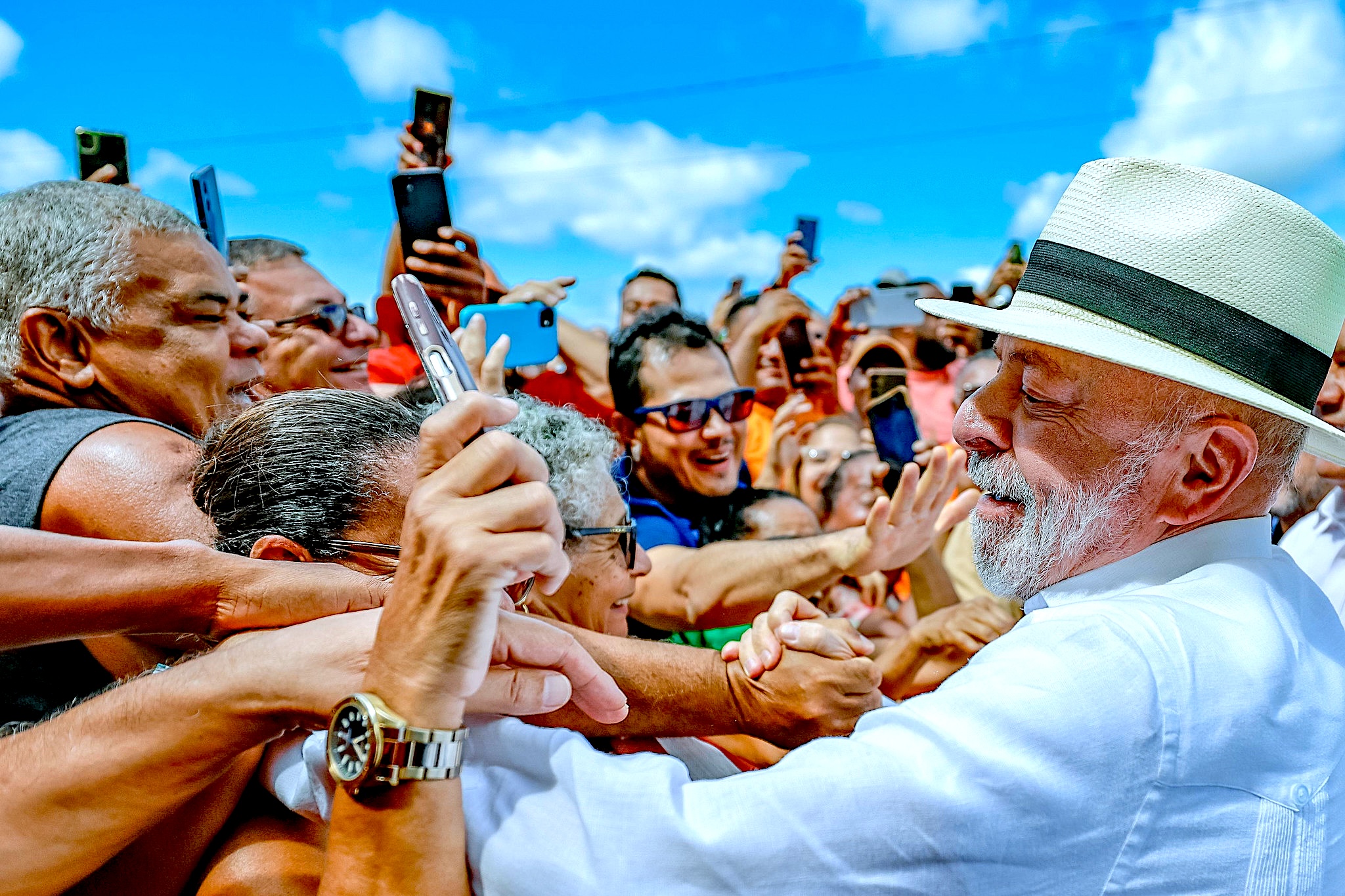
Brazil’s President Luiz Inácio Lula da Silva with supporters in Alagoinhas in July. (Palácio do Planalto /Flickr/ CC BY-ND 4.0)
By Guilherme Casarões
Florida International University
Three weeks ago, Brazilian Preside nt Luiz Inácio Lula da Silva’s political obituaries had all been written.
The far-right presidential candidate, Flávio Bolsonaro, son of the jailed former President Jair Bolsonaro, had come out of the first round of the presidential election with a lead that looked impossible to overcome.
At 80 years old, Lula seemed headed for a quiet exit after four decades at the centre of Brazilian political life.
On Sunday, however, Lula proved everyone wrong. He won the runoff and secured a fourth non-consecutive term as Brazil’s president.
A Night of Firsts
The election result is unprecedented in Brazilian politics in at least three ways.
First, no Brazilian presidential candidate had ever won the first round and then lost the runoff. Since the two-round system was adopted by the 1988 Brazilian Constitution, the first-round leader had always gone on to win.
Lula broke that pattern by turning a defeat of around 2.2 million votes in the first round into a solid victory, in three weeks.
Second, no Brazilian president has ever been elected to four terms. When his new term ends, Lula will have governed Brazil for 16 (non-consecutive) years – the longest democratically elected tenure in the country’s history.
Only Getúlio Vargas governed longer. He held power for almost two decades through a revolution, dictatorship and democratic election from the 1930–50s, and is widely considered Brazil’s most consequential president.

Vargas, center, in 1930. (Claro Jansson/Wikimedia Commons/Public Domain)
Third, no runoff campaign in Brazil has ever brought so many people to the streets and onto social media, supporting both sides.
Unlike the first round, the second round was not quiet, nor was it decided by television ads. Brazil saw a mass mobilization of voters, and it was ferocious.
The Brazilian left fought an uphill battle against social media platforms, economic elites, and a Supreme Electoral Court whose president was accused of trying to tip the balance to favour Bolsonaro.
Lula has a long record of political miracles, and he has added another one to the list.
A Result That Matters Beyond Brazil

U.S. President Donald Trump facing Sen. Flávio Bolsonaro during a White House meeting in May as other Brazilian politicians look on. (Donald Trump/Truth Social/Wikimedia Commons/Public Domain)
Lula’s victory matters well beyond Brazil’s borders, also in three ways.
Globally, Brazil remains a bulwark against the rise of the far right. In recent elections across Latin America and Europe, far-right parties and leaders have advanced almost everywhere.
Brazil, the world’s fourth-largest democracy, has now bucked the trend, and is a symbol that democrats elsewhere will not ignore.
Regionally, Lula has defied the “incumbent curse.” Over the past decade in Latin America, governing parties have lost election after election, punished by voters for inflation, insecurity and economic stagnation.
Brazil’s economy was in reasonable shape, but its gains were modest and unevenly felt. Everything pointed to a defeat, and Lula beat the odds anyway.
His win is also a check on what critics have called the “Donroe Doctrine”, referring to the Trump administration’s push to bring the Western Hemisphere more firmly into the U.S. sphere of influence through tariffs, threats and political patronage.
Bolsonaro had campaigned as Washington’s preferred partner in South America. Brazil’s voters turned that offer down.
Under Flávio Bolsonaro, U.S. military operations on Brazilian soil are a real possibility, argue Alexander Main and @GuillaumeLong.
https://t.co/ZtAlWMDSY9— Foreign Policy (@ForeignPolicy) October 25, 2026
Domestically, the result also shows the power of popular mobilisation on the left. After Lula’s poor first-round showing, Lula’s campaign re-energised demoralised supporters and built a broad coalition of voters, some of whom were voting less for Lula than against what Bolsonaro represents. It also mobilised people who had stayed home in the first round to get out to vote.
Battle Not Over
Lula should not mistake survival for vindication. Yes, he corrected course. In three weeks, he acknowledged the mistakes he made over four years in office, especially during a lacklustre first-round campaign. He sharpened his message, widened his alliances and spoke directly to the voters he had lost. That is no small achievement for a politician, however experienced he may be.
But he now has to govern a country more polarised than ever. Political violence on the streets has increased and hate speech circulates freely online.
Prominent figures on the far right, including Nikolas Ferreira and Lucas Pavanato, have already said they will not accept this election result. Bolsonaro said late Sunday he will not concede and will seek an annulment of the vote.
And then there is Washington. Given the White House’s close ties to the Bolsonaro family, there is a real risk the Trump administration will question, or even refuse to recognise, the outcome of the election. That would be extraordinary, and a few years ago, it would have been unthinkable.
Things are further complicated by a legal battle on election day itself. After allegations of voter suppression of Lula’s supporters in several cities, the justices of Brazil’s Supreme Court and Supreme Electoral Court clashed over whether to extend voting hours. Whatever the legal merits, the dispute gives the losing side a ready-made narrative of “voting irregularities.”
This could be a matter of serious concern, and it may last for weeks.
3 Questions for Lula’s Next Term

Pillars outside Brazil’s Supreme Federal Court in Brasilia. (Nicholas Bittencourt/Wikimedia Commons/CC BY-SA 2.0)
When Lula is inaugurated on Jan. 5, three questions will define his fourth term.
The first is how Lula will govern a deeply divided country with a conservative majority in Congress and over a dozen right-wing state governors.
The legislature that held him hostage over the past four years has grown more hostile, not less. Every budget, every reform and every appointment will be a tough negotiation, with the possibility of an impeachment hanging over Lula’s head.
The second is repair. How will he deal with problems that go well beyond partisan disputes?
These include fiscal pressures from rising government spending, a steady loss of trust in democratic institutions and an institutional system that no longer works as designed.
The Supreme Court, once the guarantor of the democratic order, has seen its legitimacy eroded by a major financial scandal surrounding Banco Master. Although the president cannot “repair” a court, he can refuse to treat the crisis as someone else’s problem.
The third question is the most important. Will Lula, his Workers’ Party (PT) and Brazil’s broader democratic forces use this reprieve to renew Brazilian politics? That would mean:
- new political leadership alternatives beyond the ageing leaders who have dominated the left for 40 years
- new forms of popular political participation that do not depend on a single charismatic figure
- a new narrative that speaks to the precarious workers, religious families and angry voters who have drifted toward the far right.
This is the only real antidote to polarisation, and it will not come from a single election or a single leader.
Lula’s comeback has bought Brazil time. Whether it buys anything more depends on what he and his allies do over the next four years, one step at a time.
Lula has worked another miracle. His last task is to make sure Brazil does not need another one.
Guilherme Casarões is associate professor of Brazilian studies, Florida International University
This article is republished from The Conversation under a Creative Commons license. Read the original article.
The views expressed are solely those of the author and may or may not reflect those of Consortium News.
The truth is that the BRICS nations are also part of the New World Order; they accept the economic order dictated by the IMF and the World Bank. Two years ago, Lula opposed the entry of communist Venezuela into the BRICS, and he embraces the AI-driven biometric tracking system pushed by the transhumanist banking oligarchy—the “full-spectrum dominance” of an electronic cage in which we will all be imprisoned. It is a dystopian, technocratic nightmare. It is likely that parts of the Amazon will be repurposed for massive data centers. As for Trump, he, too, is a puppet of the financial establishment—specifically, the more thuggish, gangster-like faction that they choose to fund…
I am not in agreement with all the posted bullets. Single charismatic figures ARE needed with a team who are intelligent, but not necessarily “well educated”, rather good communicators and genuinely understand where the people in the Vargas photo are not only coming from but what keeps them “bound”. Institutes of higher learning are failing the world over and autodidacticism must return and be valued. All learning does not need direction. It needs passion. In religion it is to know and feel a living deity, or in indigenous peoples deity is what nourishes us in reality and a belief in no see ums which is much the same kind if faith one must have in god. With improvement in microscopes, science is seeing the “no see ums” for the first time and upon which it is speculated all life on earth depends upon the micro life of living organisms in soil and ocean which we are decidely killing due to things like ignorance, hubris, greed and lack of an ability to believe in what you cannot see.
If you simply only note the diversity in the photo and the person at the center, not at all disturbed by the representatives you see around him nonchalantly lighting a cigar. What a wonderful picture. As if managing differences were an easy task especially if the victims of war, genocide and poverty unite to form a union for all. Find what binds/bonds us and that’s the kind of picture you get. I find it fascinating as well as beautiful. Hope Lulu earns the comparison.
Lula’s ‘Miracle’ Victory in Brazil – thank god.
There’s a fourth question.
How/when is Lula and ‘his’ party going to encourage and nurture some to succeed him?
His re-election may be a miracle – but there’ll be no miracle concerning how long he’s able to govern for, sooner or later his number will be up.
How long will he last if the US hierarchy doesn’t want him there?
Depends on how US evolves in next few years. World is tiring of US imperialism including a majority of US citizens.
I’d say it depends on how patriotic and competent Lula’s counter-intelligence, counter-propaganda, and personal-protection services are. Hopefully, more than Evo Morales’s and Nicolás Maduro’s were. In Latin America, the price of democratic sovereignty is eternal vigilance against US-engineered régime-change ops. Cuba has taken that lesson very seriously and never forgotten it; most of the other countries haven’t.
Flavio, the “golden” apple of the Bolsonaro family tree has fallen, not far from its stump, despite at the behest of the “yellow-haired” scion of the Trump tree to once again, follow his trajectory to global disaster.