The party’s grassroots have crossed into political territory that was supposed to remain untouchable, writes Ramzy Baroud.

A key representing the right of Palestinian return at a Nakba Day demonstration in Berlin in May 2015. (Montecruz Foto, Wikimedia Commons, CC BY-SA 2.0)
 The Green Party has put the conversation back on track: the problem is not the lack of creative solutions to the Israeli occupation of Palestine. The problem is Zionism itself.
To appreciate the significance of Motion A105, adopted by the Green Party of England and Wales on Oct. 4, consider its basic tenets.
The party is now formally anti-Zionist. It endorses the Palestinian right of return, supports one democratic state throughout historic Palestine, reaffirms its commitment to the Boycott, Divestment and Sanctions (BDS) movement, distinguishes anti-Zionism from anti-Semitism and calls for a full arms embargo against Israel.
Though the decision may seem revolutionary within British politics, it is hardly revolutionary when examined against the history of Palestinian dispossession, beginning long before the Nakba of 1948.
Indeed, the Greens were not the first to equate Zionism with racism. That history owes much to Africa’s anti-colonial movements and their struggle against apartheid.
In 1975, the Organization of African Unity, meeting in Kampala, Uganda, drew explicit parallels between the racial systems governing South Africa, Rhodesia and occupied Palestine, identifying their common imperialist origins.
This position helped lay the groundwork for U.N. General Assembly Resolution 3379, adopted on Nov. 10, 1975, which determined that Zionism was a form of racism and racial discrimination.
Under intense American and Israeli diplomatic pressure, the UN eventually reversed that determination on Dec. 16, 1991.
[See: The UK Role in Ending UN’s 1970s Anti-Zionism Stance]
UN Failed to Require Israel to End Discrimination

Flag of Israel outside the U.N. in 1975. (Dan Hadani Collection / National Library of Israel / The Pritzker Family National Photography Collection/ Wikimedia Commons/ CC BY 4.0)
Israel, however, was not required to dismantle the discriminatory structures that had prompted the original condemnation. The revocation changed the U.N.’s position, not the realities confronting Palestinians.
Those who yielded to American pressure in 1991 must therefore confront a troubling question of moral responsibility: did their decision help legitimize the very political structures that have sustained Palestinian dispossession, occupation and settler colonialism?
The Greens have now reopened that historical debate. But they have also done something more consequential.
By adopting the motion with 1,022 votes against 813, party members demonstrated that ideas once dismissed as radical are increasingly challenging the boundaries of mainstream British politics.
Yet within this achievement lie important fault lines, revealing the nature of the struggle ahead.
Four of the party’s five MPs opposed the resolution. More tellingly, Sandy Ruthven, chair of Amnesty International U.K.’s charitable trust, resigned his Green Party membership altogether.
In explaining his decision, Ruthven accused the party of seeking to court the hard-left vote while failing to confront prejudice within its own ranks.
BREAKING: Amnesty International UK chair Sandy Ruthven has left the Green Party following the party’s adoption of its ‘Zionism is racism’ motion at its conference over the weekend.
https://t.co/gkeIb29du6
? Sky 501, Virgin 602, Freeview 233 and YouTube https://t.co/gbhavSyY9D
— Sky News (@SkyNews) October 5, 2026
His resignation exposes a contradiction worth examining, particularly given his association with an organization that has already documented Israeli apartheid against Palestinians.
In February 2022, Amnesty International published a landmark report concluding that Israel maintained an institutionalized system of oppression and domination over Palestinians amounting to apartheid.
That recognition was belated, but critically important. Apartheid, however, does not emerge in an ideological vacuum. It is sustained by political assumptions about belonging, sovereignty, demographic control and the unequal distribution of rights.
The question, therefore, is not merely whether Israeli apartheid exists, but what political principles have made its establishment and perpetuation possible.
The Zionist movement emerged in late 19th-century Europe as a nationalist project seeking a Jewish homeland, eventually pursuing Jewish statehood in Palestine. Its implementation ultimately led to the mass displacement of Palestinians in 1948.
Guardians of Permissible Discourse
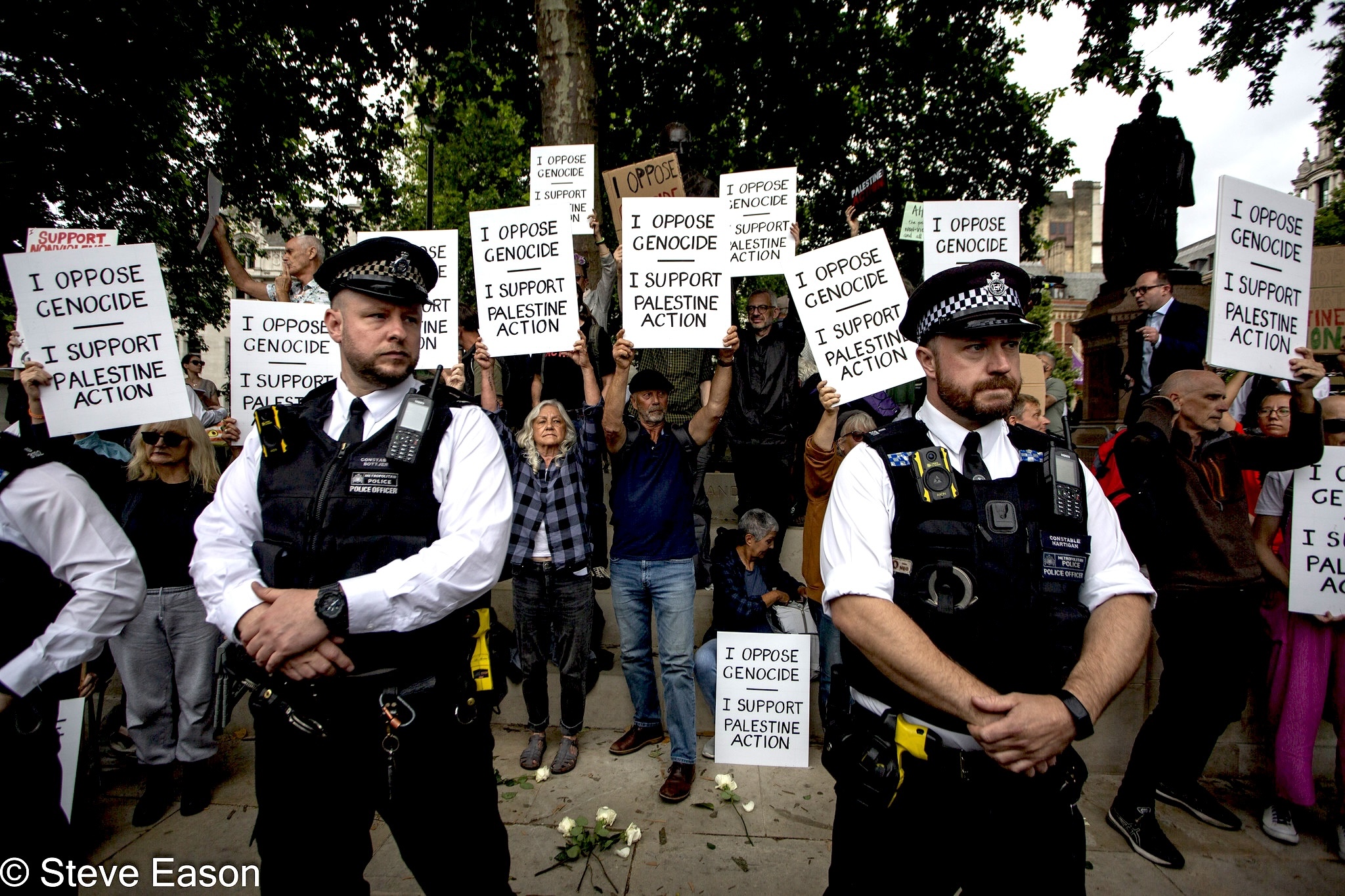
Protesting the banning of the direct-action group Palestine Action using anti-terrorism laws, Parliament Square, London, July 5, 2025. (Steve Eason, Flickr, CC BY-NC 4.0)
The connection between that foundational project and the discriminatory structures documented by Amnesty itself is impossible to ignore. How, then, can the likes of Ruthven condemn apartheid without confronting the ideology that underpins it? And if that ideology is not Zionism, what is it?
The larger issue, however, is not a lack of historical knowledge among Britain’s political and intellectual elites.
Rather, these elites have long positioned themselves as guardians of the permissible discourse on Israel and Palestine — a narrative that accommodates occasional criticism, sometimes even harsh condemnation, but rarely permits a fundamental challenge to the political structures themselves.
The Green Party’s grassroots have now challenged that conventional wisdom. They have crossed the boundary separating what may be criticized from what must remain politically untouchable.
Due to the ongoing Israeli genocide in Gaza, the Greens have effectively declared that the time for carefully managed criticism has passed.
In doing so, they have opened a political space that others may eventually occupy, including within the Labour Party, historically divided between its progressive grassroots and an increasingly centrist leadership whose policies, particularly on Palestine, have become virtually indistinguishable from those of the political right.
The vote could also encourage similar debates across Europe, challenging political parties to confront the relationship between Zionism, antisemitism, Palestinian rights and the future of historic Palestine.
But perhaps the Greens’ most consequential contribution is that they have challenged the very premise of the debate. For decades, international diplomacy has focused overwhelmingly on finding solutions while leaving the ideological foundations of the existing political order largely unexamined.
The Greens have reversed that approach, essentially declaring that no political solution in Palestine, however idealistic or supposedly pragmatic, can coexist with Zionism.
The backlash against the Greens was, of course, expected. But so, too, is the growing determination of British voters to challenge the boundaries of permissible debate across the political spectrum.
Dr. Ramzy Baroud is a widely published and translated author, an internationally syndicated columnist and editor of The Palestine Chronicle. His latest book is The Last Earth: A Palestinian Story (Pluto Press, 2018). He earned a Ph.D. in Palestine Studies from the University of Exeter (2015), and was a non-resident scholar at Orfalea Center for Global and International Studies, UCSB. Visit his website.
This article is from Z Network, is funded solely through the generosity of its readers.
Views expressed in this article and may or may not reflect those of Consortium News.
Distinguishing anti-Zionism from anti-Semitism is essential to see clear.
The mass murder of totally help- and defenseless children, women and men of Palestine is going on 24/7!
International sufficiently equipped and armed forces are more than urgently needed on the ground in Palestine to protect the people from the plundering mass murderous zionists.
Now!!!
Justice must finally be established, and the responsible criminal individuals held accountable!!
Especially also those from behind the scenes, pulling the puppet strings!
“His resignation exposes a contradiction worth examining, particularly given his association with an organization that has already documented Israeli apartheid against Palestinians.”
really. i think it must examine something more than just a contradiction.
We need to be a bit braver in our language. Is the problem Judaism?
And there lies our problem. Because there are many Jews (even in Israel) who not only think Israel’s behaviour wrong, who not only say Israel’s behaviour is wrong, but also take action to support those beliefs.
And the “free” press of the western world makes sure we never hear. So who is it who really drives this?
How do you account for 80-85% of Israelis backing their operation in Gaza and well over 90% of them backing the illegal Israeli-US invasion of Iran?
“At Last” as performed by Etta James, comes to mind.