Nicolas J. S. Davies urges a special session of U.N. General Assembly aimed at taking concrete actions for Palestine for which people all over the world are calling.
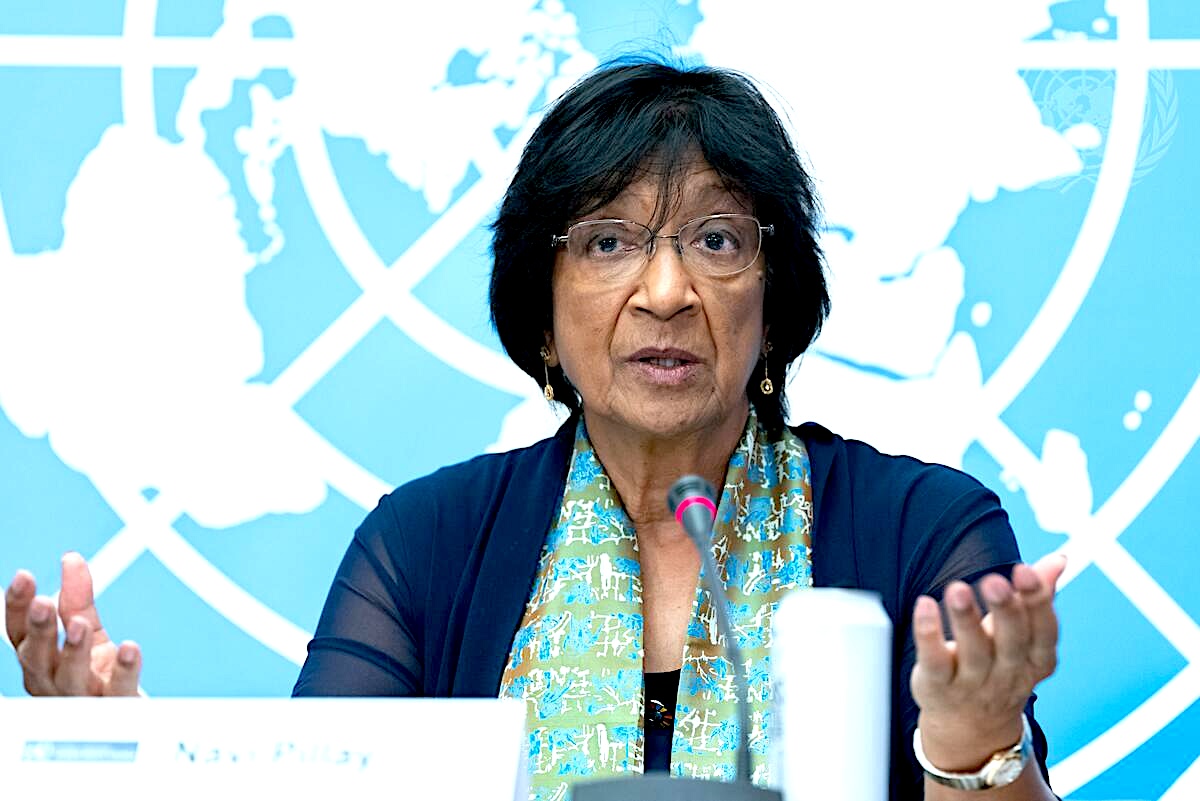
Navanethem Pillay, chair of the U.N. Independent International Commission of Inquiry on the Occupied Palestinian Territory, including East Jerusalem, and Israel, briefing reporters in 2022. (UN Photo/Jean Marc Ferré)
By Nicolas J. S. Davies
Common Dreams
 On Oct. 9, the 2026 Nobel Peace Prize Was awarded to Navi Pillay, the South African international lawyer who defended Nelson Mandela and the anti-apartheid political prisoners on Robben Island, and went on to serve as a judge on the U.N. International Criminal Tribunal for Rwanda and the International Criminal Court (ICC), then as U.N. high commissioner for human rights.
In 2025, Navi Pillay led the U.N. Commission of Inquiry that confirmed that Israel is committing genocide in Gaza.
With the world in the grip of seemingly intractable war and chaos, the Nobel Committee clearly wanted to honor someone who has worked against the tide of militarism and violence to uphold international law.
And yet, on the same day, the United States unveiled unilateral, illegal coercive measures or “sanctions” against the ICC, where Navi Pillay served as a judge from 2003 to 2008.
The U.N. General Assembly’s 2026 general debate in September also set out to uphold the U.N. Charter and international law, and to confront the reality that the U.N. system is failing in its most basic responsibility, to maintain international peace and security.
The foundational rules of the U.N. Charter are that countries must resolve disputes peacefully and refrain from the threat or use of force.
But in the General Assembly debate, even as leaders recognized the urgent need to finally enforce the U.N. Charter, after decades of impunity for aggression and war crimes, they were reluctant to explicitly address the central role of the United States in undermining the rule of international law.
Many U.S. allies loyally condemned Russia’s violation of the U.N. Charter against Ukraine. But none of them even tried to square their singular focus on Russia with the inconvenient truth that their own ally, the United States, has systematically violated the U.N. Charter for decades, against Grenada, Nicaragua, Panama, Yugoslavia, Afghanistan, Iraq, Haiti, Libya, Somalia, Syria, Yemen, Venezuela, Cuba, Iran and other countries.
While U.S. allies remain silent, U.S. officials accept no responsibility or accountability for the violence and chaos they unleash and instead keep doubling down on their failed imperial ambitions and military approach to international disputes, the very antithesis of what the U.N. Charter requires.
Many other leaders spoke out, but without explicitly naming the United States. Algeria’s foreign minister, the veteran diplomat Ahmed Attaf, pointedly asked,
“What sort of international order can function properly when principles are selected according to the identity of those who violate them? What confidence can remain in international law when the aggressor is granted the right to self-defense, while the victim is required to justify even the right to survive?”
So it is left to the officials of the countries the United States threatens or attacks to remind the world which country is illegally threatening them, as Cuba’s Foreign Minister Bruno Rodriguez Parrilla and Iran’s President Masoud Pezeshkian did clearly and accurately at the General Assembly.
Many other leaders made strong statements condemning Israel’s war crimes and genocide in Gaza, even as they neglected to condemn the essential U.S. military and diplomatic role in them.
King Abdullah of Jordan described Israel’s objective as “to make a viable Palestinian state impossible,” through “a system of subjugation… de facto annexation… forced displacement… (and) war crimes.”
“We have tools,” he reminded his colleagues, “Sanctions, asset freezes, embargoes, diplomatic isolation. And we have a record of using them elsewhere… The question now is: Will we act?”
Reconvening an Emergency Session on Israeli Actions

Bangladesh’s Khalilur Rahman, new president of General Assembly, on Sept. 29. (UN Photo/Manuel Elías)
Another of the U.N.’s tools is the power of the president of the U.N. General Assembly to convene Emergency Special Sessions (ESS) that can pass “uniting for peace” resolutions. This allows the General Assembly to act decisively on international problems when the Security Council fails to do so, wielding the kind of tools that King Abdullah outlined.
The General Assembly’s 10th Emergency Special Session on “Illegal Israeli Actions in Occupied East Jerusalem and the Rest of the Occupied Palestinian Territory” began in 1997, and has been reconvened more than 20 times.
In 2022, the 10th Emergency Special Session voted to ask the International Court of Justice (ICJ) some legal questions about the Israeli occupation, which the court answered in 2024, in a finding that the Israeli occupation is illegal and that Israel must “end its unlawful presence in the Occupied Palestinian Territory as rapidly as possible,” and “evacuate all settlers.”
The next meeting of the 10th ESS in September 2024 passed a resolution demanding that Israel comply with the ICJ ruling and withdraw from the occupied territories within a year.
However, the 2025-6 General Assembly president, Annalena Baerbock of Germany, allowed her entire year as president to pass without reconvening the 10th ESS even once.
This allowed U.S. President Donald Trump and Israeli Prime Minister Netanyahu to seize the initiative and subject the people of Gaza to a new phase of the genocide under Trump’s Orwellian “board of peace,” a smokescreen for a war of attrition to keep killing civilians and making life intolerable for the people of Gaza, as they struggle to survive in the rubble of their bombed and bulldozed homes.

Delegations at the U.N. General Assembly walking out on Netanyahu’s speech on Sept. 24. (UN Photo/Loey Felipe)
Many leaders at the General Assembly spoke of the urgency of reforming the Security Council, but the greatest leverage they have to achieve that is the General Assembly’s ability to act in an Emergency Special Session when the dysfunctional, corrupted Security Council fails to do so.
Nowhere in the world is such action more urgently needed than in Palestine. And yet the 10th Emergency Special Session has not met since June 2025.
Now that Bangladesh’s Dr. Khalilur Rahman has taken Baerbock’s place as president of the General Assembly, he should reconvene the 10th Emergency Special Session to take the concrete actions for Palestine that people all over the world are calling for.
South Africa’s genocide case against Israel at the ICJ is also important, but South Africa has slowed down the already tortuous pace of international justice by requesting 18 months to respond to Israel’s defense against genocide charges.
Surely South Africa and the court can find a way to move faster, with the fate of an entire people in the balance. The Genocide Convention was intended to prevent and stop genocide, not just to pass judgment over mass graves and scattered refugee camps.
Many people justifiably fear that the United Nations and its institutions are simply too weak to enforce the laws of the U.N. Charter and the Geneva Conventions and hold the United States and Israel accountable for their crimes.
But there was another event on Sept. 16 that suggests that Benjamin Netanyahu and other U.S.-allied war criminals might want to think twice before assuming that the United States will always shield them from accountability.
Hashim Thaçi Sentenced for War Crimes

Kosovo’s Representative Hashim Thaçi, left, with Farid Zarif, head of the U.N. Interim
Administration Mission in Kosovo, during a Security Council meeting on UNMIK in May 2015 (UN Photo/Rick Bajornas)
The week before the General Assembly met in New York, an international war crimes court in The Hague sentenced former Kosovo president Hashim Thaçi to 25 years in prison.
The court found Thaçi and three other former leaders of the U.S.-backed Kosovo Liberation Army (KLA) guilty of 96 murders, 303 charges of torture, 49 charges of criminal cruelty and 385 cases of arbitrary detention, committed during the U.S,-NATO war on Yugoslavia in 1999.
The Kosovo Specialist Chambers, the court that tried Thaçi, was established in 2011, in response to a Council of Europe Parliamentary Report titled “Inhuman Treatment of People and Illicit Trafficking in Human Organs in Kosovo.”
That report detailed extraordinary allegations unearthed by Carla Del Ponte, who was the chief prosecutor of the International Criminal Tribunal for the former Yugoslavia (ICTY), which were then investigated for the Council of Europe by Swiss state prosecutor and Member of Parliament Dick Marty.
The report substantiated allegations that the KLA transported civilian prisoners from Kosovo to Albania and imprisoned them in a clinic known as the “Yellow House,” where they murdered them and extracted their internal organs to sell on the illicit organ transplant market.

Del Ponte during a press conference in June 2015. (UN Photo/Jean Marc Ferré)
As the court records show, these were only the most startling of Thaçi and the KLA’s crimes. The KLA also shot, tortured or beat to death dozens, or maybe hundreds, of civilian prisoners whom it labelled as “traitors” or “collaborators,” during and immediately after NATO’s illegal war to detach Kosovo from the remaining territory of Yugoslavia.
While no Americans were charged in these crimes, the C.I.A. and other Western intelligence agencies had worked with the KLA since at least 1996, as it terrorized Serb civilians and attacked and killed Yugoslav police to provoke repression against the Kosovar Albanian population.
The escalating violence in Kosovo provided the pretext for a war in which the United States and NATO dropped 23,000 bombs and missiles on Yugoslavia, targeting and destroying vital civilian infrastructure as well as military targets.
Then they invaded and occupied Kosovo and built a huge U.S. military base, Camp Bondsteel, which the U.S. also used as a secret prison during its “war on terror.”

Aerial photo of Camp Bondsteel in Kosovo, 2000. (Task Force Falcon Public Affairs Office. KFOR/Wikimedia commons/ Public Domain)
U.S. Secretary of State Madeleine Albright was so personally invested in the march to war in Kosovo that Time dubbed it “Madeleine’s War.”
Albright shunned the traditional political leaders of Kosovo’s independence movement, and instead embraced Hashim Thaçi and the KLA as the United States’ and NATO’s main allies in Kosovo, despite their well-known links to organized crime and heroin smuggling.
With Thaçi at her side at the Rambouillet conference in France, Albright delivered her coup de grace to Yugoslav President Milosevich: an ultimatum that would have given NATO the right to militarily occupy all the remaining territory of the Federal Republic of Yugoslavia.
Milosevich’s refusal to surrender his country’s sovereignty served as the final pretext for the U.S. and NATO to violate the U.N. Charter in an illegal war that set a precedent for U.S. invasions of Afghanistan and Iraq and the endless wars and chaos that have followed.
At the U.N. General Assembly on Sept. 23, Serbian President Aleksandar Vucic thanked the 107 countries that still refuse to recognize Kosovo’s unilateral declaration of independence from Serbia in 2008, and he placed NATO’s war on the remains of Yugoslavia in 1999 squarely at the root of the violence and chaos afflicting the U.N. and the world.
“. … the order based on respect for the U.N. Charter and the law founded upon it no longer exists,” Vucic said. “It was destroyed by those who tore apart the territories of other countries for the sake of their own political and economic interests. They did so unscrupulously, recklessly, and shamelessly.”
So is it already too late to try to enforce the rules of the U.N. Charter?
Has the world simply failed to learn the lesson of 1945 that “might makes right,” coupled with the destructive power of modern weapons, can only create a world plagued by endless war and chaos?
Or, now that we are staring that world in the face, will we finally heed that lesson and make different choices?
It has taken 27 years for justice to catch up with Thaçi, but, as King Abdullah said, the world’s governments have the tools to enforce the rules of international law if and when they choose, and that is true even in the case of U.S. allies like Thaçi and Netanyahu.
But Abdullah’s question remains: will the world’s leaders choose to use the tools at their disposal? First to free Palestine, but also to give our own children and grandchildren the chance to build a peaceful, sustainable world out of the militarism, war and chaos that is the global legacy of a generation of American leaders.
Nicolas J. S. Davies is an independent journalist and a researcher with CODEPINK. He is the co-author, with Medea Benjamin, of War in Ukraine: Making Sense of a Senseless Conflict and the author of Blood On Our Hands: the American Invasion and Destruction of Iraq.
This article is from Common Dreams.
The views expressed in this article and may or may not reflect those of Consortium News.
This is an excellent piece of work. I’ve read it three times, it’s that good.
The mass murdering criminal syndicate(s), disguising as states, actually having usurped the governments of the united states and(!) what is still called ‘israel’, must be expelled from the UN.
These severe criminals are blocking any kind of constructive development and of course continue to steal and murder, as long as not prevented, as can clearly be seen for many decades by now.
The responsible individuals, especially those from behind the scenes pulling the puppet strings, must be clearly identified, exposed and held accountable.
There is more than acute reason to hurry- the mass murder of totally help- and defenseless children, women and men is continuing 24/7!!!
regarding the issue of holding perpetrai_tors accountable and
– most of – the int’l community wishing convictions be swift,
‘truthout’ just published a piece on ways to fight back against
#47’s sabotaging the ICC. [mind-boggling how much pressure
the US exerts on so many countries just by threatening to with-
draw funds!] still, fighting back takes time we wish it didn’t.
hxxps://truthout.org/articles/as-trump-sabotages-the-icc-with-sanctions-there-are-many-ways-to-fight-back/
while my EU country – claiming to have come to grips w its nazi past –
CON_tinues to be the 2nd largest supplier of arms to israel. *sigh!*
thank you very much for this informative
reminder, and recapitulation, of events!
i remember my huge disappointment when my EU country’s
then foreign minister, member of the green party [of all parties!],
made us believe we have to go to war bc srebrenica should not
turn into another auschwitz. an outrageous analogy to be made!
some say: “hope always dies last.”
others say: “hope shall prevail!”
still others claim: “peace does not pay!”
if they CON_tinue to have their say —
and as long as convictions take decades,
it’s hard to have faith in things improving.
but we do. and try to contribute what
little we can to make it happen, within
our lifetime, preferably ;-)
NATO is the gangster alliance of the Neo colonial order. When the citizens of NATO member countries stand up demand that NATO be shut down I fear we will be in this horror for a long time to come.
An eye-opening article. Sadly, I do not think humanity has yet absorbed the deepest lessons of WWI and WWII. The events of the decades that followed suggest that we continue to repeat the same patterns of division, competition and self-interest.
What the world needs now is strong and enlightened leadership that recognises a simple but profound truth: the human family is one. Our highest purpose is not merely to coexist, but to care for one another and work for the common good.
If this truth remains hidden beneath fear, nationalism and separation, the long-term consequences of acting against it may prove to be our greatest challenge and danger.
Thankfully, there are also signs of hope. Beyond the headlines, a number of leaders are quietly emerging who demonstrate integrity, wisdom and a commitment to the common good. They may not yet dominate the world stage, but they remind us that a more enlightened form of leadership is possible.
Yours is the best and most appropriate comment here, by far, to this wonderfully disturbing piece written by Nicolas and Medea. I would loosely go along with both your comment and their essay. Division, competition and self-interest are all not evils in themselves ; in actuality, they are all latent blessings to humanity; just awaiting enlightened leaderships to uncover their potential boon for civilizational uplifts and exponential human progress. But I must admit that most of our extant and past leaders, in the recent century or so, have learnt absolutely nothing from past wars and WW I and WW II : to them their righty-might and mighty-right has always been their supremacist right to universal might. On an optimistic note : the unfurling multi-polar or pluri-polar New Order has the consensual right to might that might RIGHT those long abusive might ! Your concluding quip on a pluralistic, and hopefully enlightened, leadership emerging from the global elitistic gutter, let us hope, shouldn’t remain just a wishful dream !
Personally, the fact we have a field for Genocide Scholar says we have been committing genocide for too long. No, we have not learned anything from WWII. Not a thing.
Yours is an important article, and cognizant of all that NATO would have us forget.