
When Palestinians are asked to begin the story on Oct. 7, they are effectively being asked to erase what came before. Justice cannot begin halfway through history, writes Mohammed Altaj.
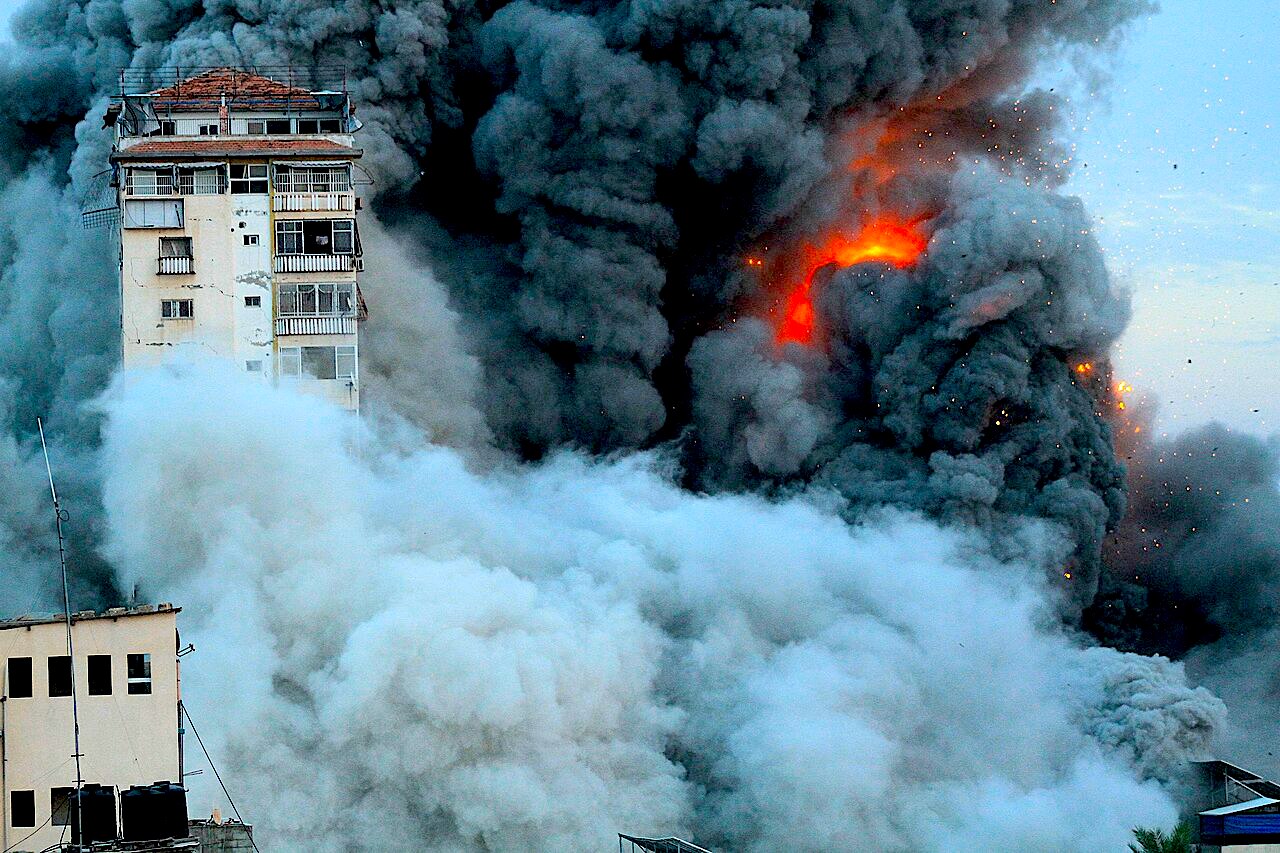
Israeli forces strike Gaza, Oct. 7, 2023. (Ali Hamad of APAimages for WAFA, Wikimedia Commons, CC BY-SA 3.0)
By Mohammed Altaj
in Ramallah, Palestine
 The world did not lack knowledge of what was happening to Palestinians.
It knew.
It knew that a people had been living under occupation for decades; that land was being confiscated, settlements expanding, homes demolished, and checkpoints cutting cities and villages off from one another.
The United Nations knew. Governments knew. Parliaments and international courts knew.
The shift now visible across significant parts of Western public opinion did not begin because the world suddenly discovered new facts about Palestine.
The facts were already there.
What changed was the distance between the news and the human being.
People saw what war means when a child is trapped beneath rubble, what displacement means when a family carries whatever it can and walks away without knowing where it will go.
And the numbers began to acquire names, faces and voices.
One of those names was Hind Rajab.
I do not mention Hind because her story encompasses everything that happened in Gaza. I mention her because some tragedies become windows through which people see what numbers alone cannot reveal.
Hind was trapped inside a car in Gaza in January 2024 after members of her family had been killed. She called for help. Twelve days later, she was found dead inside the car. The two paramedics sent to rescue her were also found dead.
But Hind was no longer a number.
That is what changed.
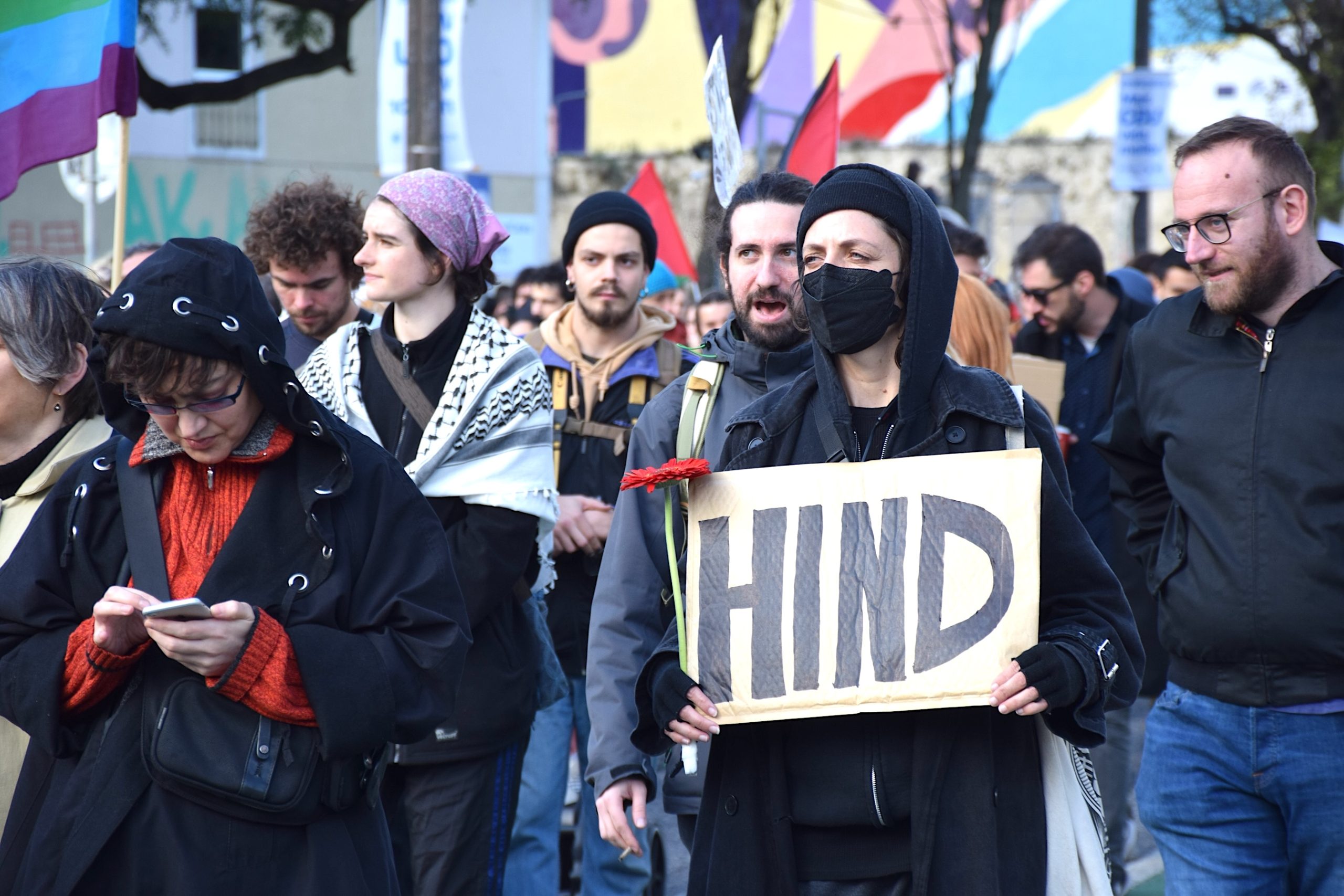
Demonstrator with “Hind” sign at a Palestine solidarity demonstration in Lisbon on Feb. 10, 2024. (Lua Eva Blue /Wikimedia Commons/ CC BY 4.0)
The world also saw seven World Central Kitchen aid workers killed in Israeli strikes while carrying out humanitarian work. And even after the ceasefire announced in October 2025, the killing did not end.
According to Palestinian Ministry of Health figures cited by the U.N. Office for the Coordination of Humanitarian Affairs, by Sept. 23, 1,402 Palestinians had been killed and 4,881 injured since the ceasefire announcement.
Bodies remained beneath the rubble, while families waited to reach loved ones not to save them this time, but to bury them.
A Too Long Story
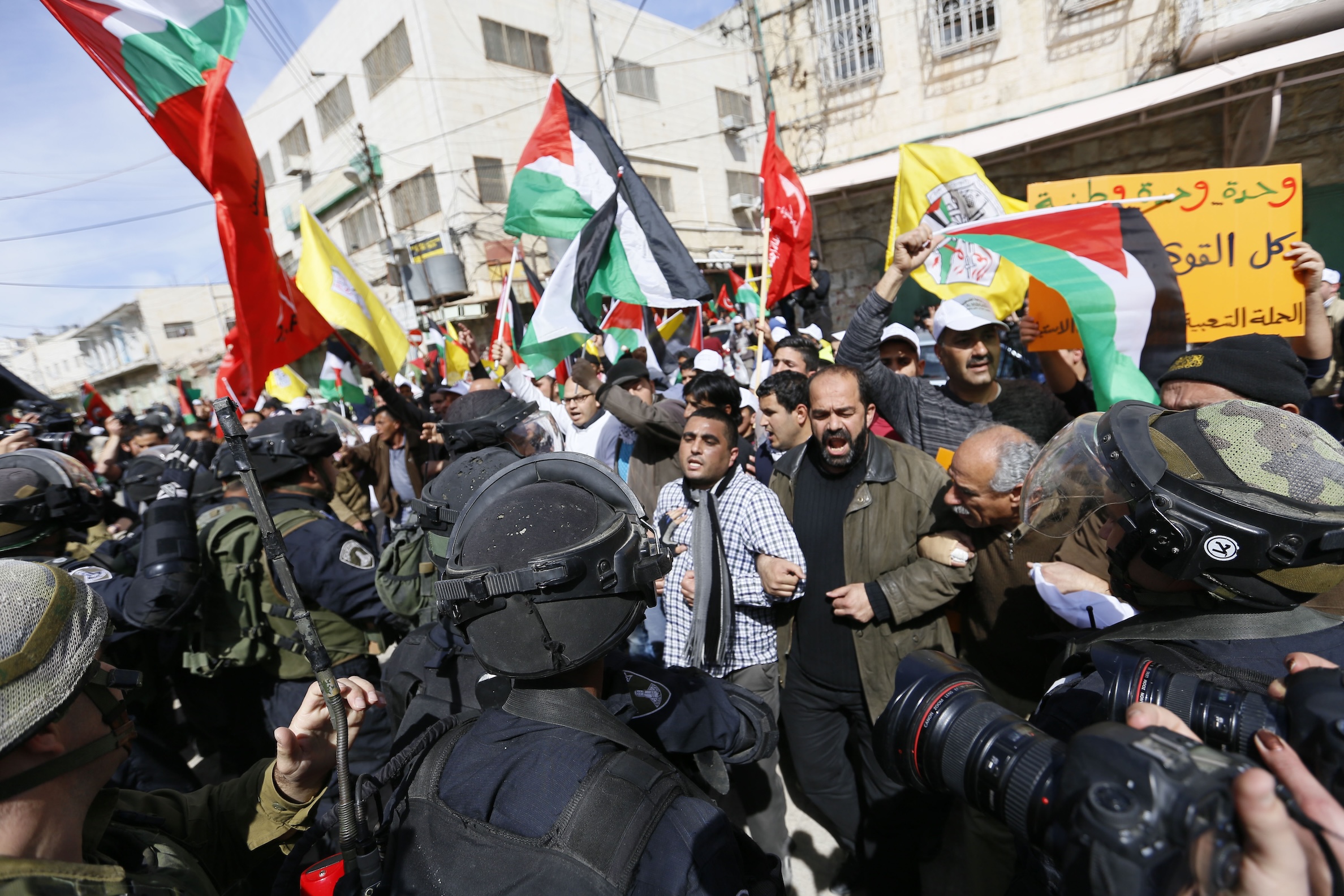
Israeli security forces preventing Palestinians from entering Al-Shuhada Street in February 2014 during a demonstration on the 20th anniversary of the massacre of Palestinians at the Ibrahimi Mosque in Hebron. (Mustafa Bader / Wikimedia Commons/ CC BY-SA 3.0)
Palestinian history did not begin in Gaza.
And it did not begin on Oct. 7, 2023.
In 1994, Baruch Goldstein, an Israeli settler and member of the Kach movement, opened fire on Muslim worshippers in the Ibrahimi Mosque in Hebron, killing at least 29 people.
In 2014, 16-year-old Mohammed Abu Khdeir was abducted from Shuafat, beaten and burned alive.
A year later, the Dawabsheh family home in Duma was set on fire while the family slept; toddler Ali and later both his parents died.
So when Palestinians are asked to begin the story on the morning of Oct. 7, they are effectively being asked to erase what came before.
None of this makes the targeting of civilians acceptable, whoever they are.
It means something else: Justice cannot begin halfway through history.
Look at the West Bank
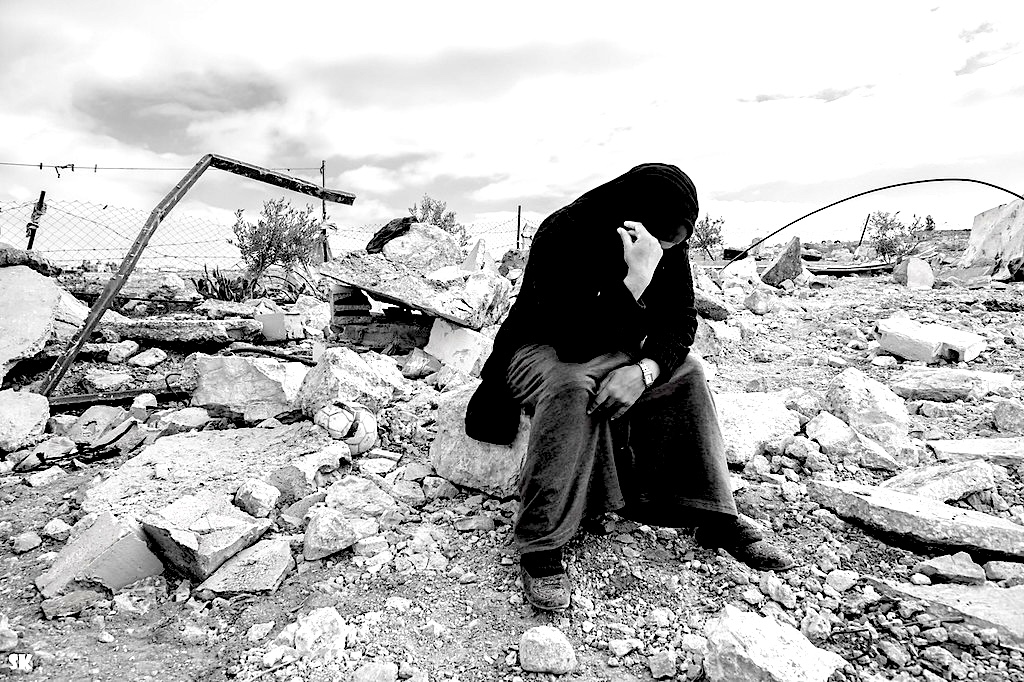
Woman sitting on the ruins of her house destroyed by Israeli authorities in Masafer Yatta, January 2023. (CC BY-SA 4.0, Wikimedia Commons)
By Sept. 14, the United Nations had documented more than 1,600 settler attacks resulting in Palestinian casualties, property damage, or both, across 275 Palestinian communities since the beginning of the year.
More than 1,500 Palestinians had been displaced because of demolitions of structures lacking Israeli-issued permits, while more than 2,600 had been displaced in the context of settler violence and related access restrictions.
And the pattern did not slow.
Between Sept. 15 and 21 alone, the U.N. documented 51 settler attacks resulting in casualties, property damage, or both. At least 800 olive, fruit and palm trees were damaged, uprooted or burned. In the same week, demolitions displaced 147 Palestinians, including 73 children.
These are not isolated incidents.
This is land being transformed, communities disappearing, families being pushed out.
This is the same process that led to the state of Israel and the Nakba of 1947-49 — the Israeli killing of thousands of Palestinians, the destruction of hundreds of villages, the confiscation of thousands of homes and the expulsion of hundreds of thousands of people from their land never to return.
The phrase “extremist settlers” is no longer enough today.
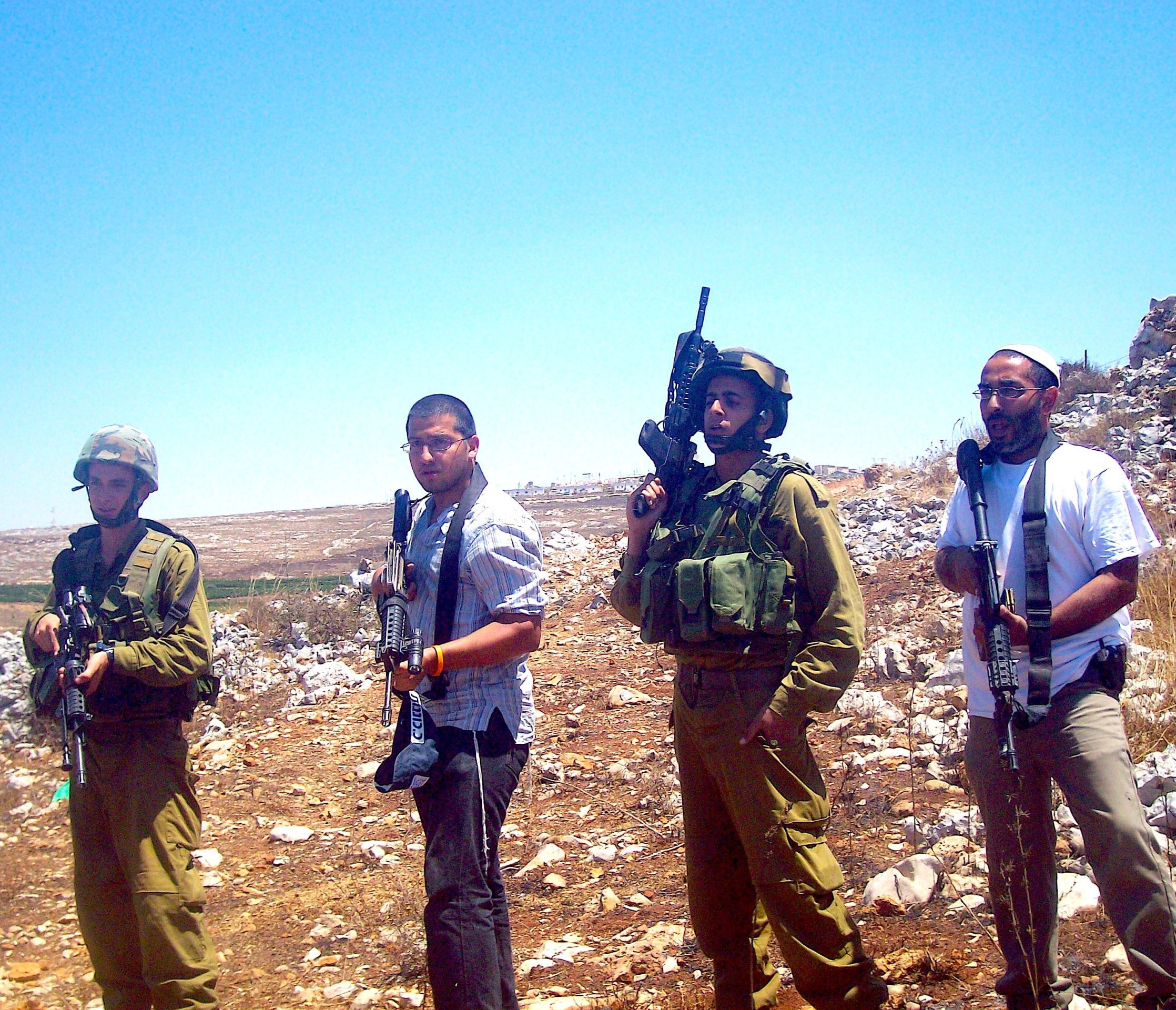
IDF soldiers and Israeli settlers during a Palestinian demonstration against settlers’ land seizure in the West Bank village of Iraq Burin in 2009. (ISM Palestine /Flickr / Wikimedia Commons / CC BY-SA 2.0)
Who plans the settlements? Who allocates the land? Who builds the roads, extends the infrastructure and provides the protection?
At what point does settler violence cease to be merely the act of an individual and become a problem with the system?
Last month, U.N. Secretary-General António Guterres warned that settlement expansion was accelerating, outposts were proliferating and settler violence was rising to alarming levels. He also warned that advancing the E1 settlement plan would deal a “deathblow” to the prospect of a contiguous and viable Palestinian state.
How, then, can the world continue to declare its support for a two-state solution while the geography on which one of those states is supposed to exist is being transformed?
The problem is not confined to land.
In Jerusalem, Christian clergy have repeatedly reported being spat at, insulted and harassed. In April 2026, a Catholic nun was violently assaulted in the Old City. A Jerusalem court later found that the defendant had committed the acts described in the indictment but acquitted him on grounds of mental illness and ordered his psychiatric hospitalization.
One incident cannot define an entire society.
But neither should repeated incidents of hostility be dismissed without asking what political and social currents allow intolerance to grow?
It is easy to say the problem is Israeli Prime Minister Benjamin Netanyahu, or National Security Minister Itamar Ben-Gvir, or Finance Minister Bezalel Smotrich.
But what if the problem runs deeper?

Aerial view of the Knesset, Israel’s parliament, in Jerusalem. (Government Press Office, Flickr, CC BY-NC-SA 2.0)
In 2018, Israel enacted the Nation-State Law, a Basic Law declaring that the exercise of national self-determination in the State of Israel is exclusive to the Jewish people and that the state views Jewish settlement as a national value.
In the 2025 Israeli Democracy Index, 71.5 percent of Jewish respondents opposed the inclusion of Arab parties in the government.
My subject is not Judaism, nor Jews around the world. My subject is the Israeli system, its laws, its policies and the political currents that allow this reality to continue.
There are Israelis who oppose occupation, settlement and racism.
But the question is not whether dissent exists.
The question is: Which ideas become laws? And which laws become policy?
When extremism moves from the margins to parliament, from parliament into government, from government into law and from law onto the land, we are no longer talking only about individuals.
We are facing a question about the system itself.
And here, too, Gaza changed something.
What once reached the world as scattered incidents is now seen every day on a screen people carry in their pockets. The effect can be measured in public opinion.
In a Pew Research Center survey conducted this spring, unfavorable views of Israel stood at 79 percent in Australia, 78 percent in Spain and Sweden, 76 percent in the Netherlands, 75 percent in Italy, 73 percent in Germany, 65 percent in Canada and 60 percent in the United States.
Perhaps Gaza did not change the values of millions of people.
Perhaps it made them realize that the values they already believed in were not being applied equally.
I do not ask the West to love Palestine.
Nor do I ask it to hate Israel.
I ask it to apply the principles it says it believes in.
If taking land by force is unacceptable, let it be unacceptable here too. If self-determination is a right, do not make the Palestinian the exception.
The law is already there.
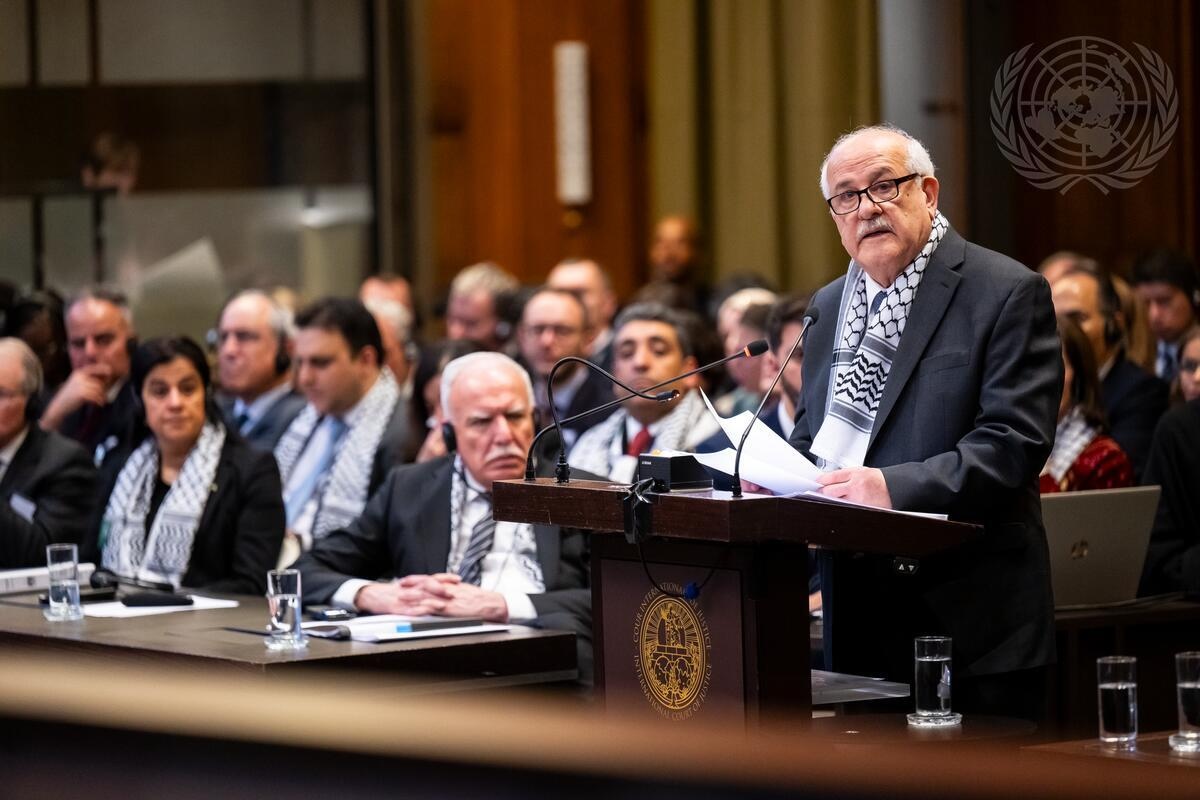
Palestine’s U.N. Ambassador Riyad Mansour addressing the public ICJ hearing on the legal consequences of Israeli policies and practices in the Occupied Palestinian Territory, including East Jerusalem, Feb. 19, 2024. (UN Photo/Frank van Beek)
On July 19, 2024, the International Court of Justice concluded that Israel’s continued presence in the Occupied Palestinian Territory was unlawful, that it was obliged to bring that presence to an end as rapidly as possible and that it must immediately cease all new settlement activity.
The Court also said that states must not recognize as legal the situation arising from that unlawful presence, nor render aid or assistance in maintaining it.
On Sept. 18, 2024, the United Nations General Assembly adopted a resolution by 124 votes to 14, with 43 abstentions, demanding that Israel end its unlawful presence in the Occupied Palestinian Territory within 12 months.
Those 12 months passed.
The unlawful presence did not end.
Settlement did not stop.
More than two years after the Court’s opinion, international warnings have become more direct.
On Sept. 22, as world leaders gathered in New York, the U.N. secretary general said that the conditions for an independent, democratic, contiguous, viable and sovereign Palestinian state were being “systematically erased.” He said support for two states must go beyond words and be reflected in policies, decisions and actions.
Two days later, the U.N. high commissioner for human rights said that the steps taken by the international community were clearly not enough and called on states to apply real political pressure to prevent the entrenchment of Israel’s unlawful presence in the Occupied Palestinian Territory.
The General Assembly’s high-level week has ended.
The world knows.
The law has spoken.
International warnings have grown sharper.
Yet the reality on the ground continues to move in the opposite direction.
So when do words become action?
Some states have taken measures against individual settlers and settlements. But if the settler alone is the problem, who built the settlement, planned it, allocated the land and protected it?
If the problem is institutional, an individual response is not enough.
Peaceful and lawful international pressure is needed on the policies and institutions responsible for perpetuating occupation and settlement, and for political, diplomatic, economic and military relations to be reviewed if non-compliance with international law continues, in accordance with the law and the obligations of each state.
The Court said what it said.
I am asking a different question: If the law determines that a situation is unlawful, and that situation continues anyway, what is the value of law if defying it carries no consequences?
This is not a call for war.
It is a call to use peace and the law to end an unlawful reality.
Palestinians waited for negotiations, for a final-status agreement, for the state they were told would come.
And while they waited, settlements grew, the land changed, and communities were displaced.
How much longer can they be asked to wait while the land meant for a future solution is transformed beneath their feet?
That is why the title of this article i s not a slogan: Israel Above the Law – Palestine Beyond Justice.
The problem is not the absence of law.
It is the distance between a ruling and its enforcement, between aprinciple and its application, between condemnation and consequence.
I do not ask the West to become Palestinian.
I ask only that Palestinians not be made an exception to its humanity — or to its law.
That the life of Hind Rajab be treated as a human life.
That the life of Mohammed Abu Khdeir be treated as a human life.
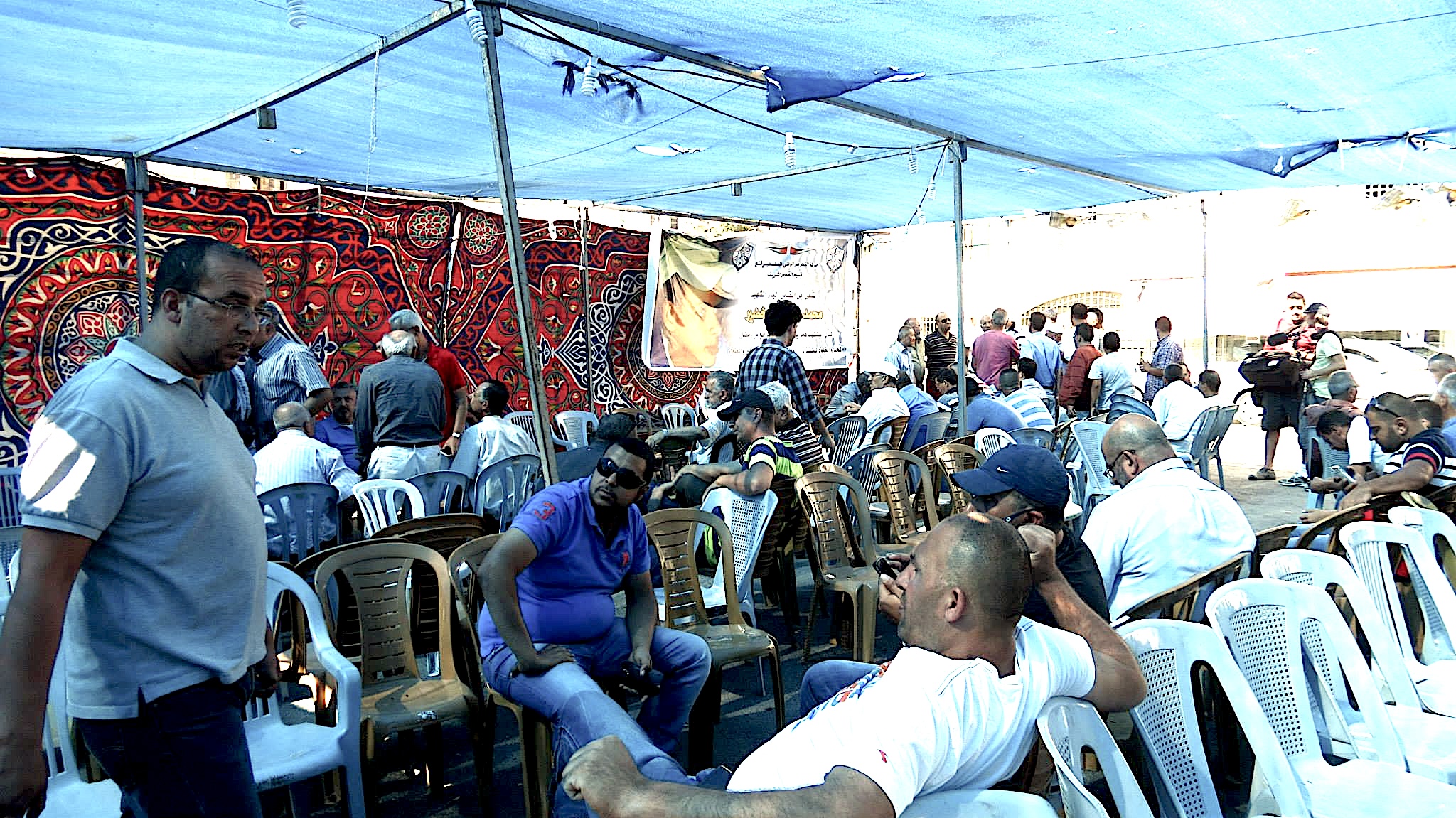
Mourning tent of Muhamed Abu Khdeir, Jerusalem 2014. (Guy Butavia/ Wikimedia Commons/CC BY-SA 4.0)
That the life of Ali Dawabsheh be treated as a human life.
That the lives of the 29 worshippers in the Ibrahimi Mosque be treated as human lives.
Because a justice that must first know the identity of the body before deciding its worth is not justice.
If occupation is unlawful, its continuation cannot be allowed to carry no consequences.
If human rights are universal, they cannot stop at the borders of Palestine.
And when the facts are clear, when the law is clear, and when the Court has spoken, the question becomes larger than Palestine and Israel: Can any state remain above the law?
And if the answer is no, then why does Palestine remain, to this day, beyond justice?
Mohammed Altaj is a Palestinian writer, political researcher and former political prisoner based in Ramallah. His writing focuses on Palestine, international law, human rights and the political consequences of occupation.
Views expressed in this article may or may not reflect those of Consortium News.
It is about time to dis- acknowledge what is still called ‘israel’, falsely acknowledged by the UN at the time?
Let us call it what it is:
Occupied Palestine.
The only legitimate state there!
‘israel’/ ‘the jewish state’ is how the mass murdering zionists want us to call it, to give their atrocious crimes a kind of legitimate frame.
Just in the same way, they abuse the jewish people to make themselves look like being part of the good ones, while having no problems also mass murdering truly jewish people, as they see fit.
See:
‘hannibal directive’
And since obviously no law in the world so far has been stopping this outright criminal syndicate, disguised as a state, a law enforcement is now(!) needed!!!
Where are the blue helmets, or any similar military force to finally help and protect the people of Palestine from the 24/7 thieving and mass murdering criminals???
‘Nonsensical Common’
Is it not oxymoronic in and of itself to state: “obviously no law in the world so far has been stopping this outright criminal syndicate, disguised as a state, a law enforcement is now(!) needed!!!”
If international rules of law have been abrogated, as it is obvious they have been, then it is utterly absurd; not rational, to be calling for “a law enforcement is now(!) needed!!!”
“Where are the blue helmets, or any similar military force to finally help and protect the people of Palestine from the 24/7 thieving and mass murdering criminals???”
“Blue Helmets” Identification: They wear distinctive light-blue helmets, berets, and insignia over their national uniforms to clearly mark themselves as neutral peacekeepers rather than combatants.”
Nowadays, definitely, when International Law is ignored, especially by the IDF; countries wearing UN insignia “over their national uniforms” is way beyond oxymoronic. It is nothing more than expectations of lunacy!
Reuters clarification: The deployment of UN peacekeepers—wearing UN blue helmets and insignia over national uniforms—amid ongoing conflicts and friction with the Israel Defense Forces (IDF) highlights a deep divide in how different nations and international bodies view the role of international law and peacekeeping.
This is the reality of the precipice at which ‘we’ the world now stand!
Thank you for asking the questions that need to be asked … and responded to by those in seats of power. It has become abundantly clear, thanks to independent journalists, that the United States works behind the scenes threatening any who would oppose their intentions. This is true at the UN, within the ICC and the ICJ. That threatening has been successful rather than being exposed and villified may, in the main, be the case because of the ample evidence of the abusive use of military and political power by the US over hundreds of years.
With great respect, I must however question your opening line: “The world did not lack knowledge of what was happening to Palestinians.” The people of the world in the main have been purposely kept in the dark by those in power who have controlled the media, what have in the past been the public’s major sources of information. It has only been with the rise and spread of independent journalism that the public has been faced with horrific realities. Even our educational institutions, including of those considered to be outstanding, have participated in reinforcing the narratives of those in power who prefer the truth be hidden.
The sad truth: the law has always, in the main, served those in power and abused the powerless.
Can we possibly hope that, out of the ongoing horrors we witness around the globe over several years, is there any possibility of true justice? Of a sea change in attitudes, thinking, behavior of those who have ordered, carried out, been complicit?
One of the major problems in the inaction of world leaders to stop this genocide is, that Epstein filmed many of them in compromising positions with children, others are bought and paid for so they won’t lift a finger to stop the heinous murder of the utterly oppressed Palestinians.
Also this oppression of the Palestinians has been ongoing for decades – long before Epstein, and the world mostly just looked on then as well.
Gods have been a problem since we invented them.
As a Canadian it sickened me to listen to our minister of Foreign Affairs Anita Anand wax on about international law and human rights and how Canada is a leader on both on the international stage Such bunk! Canada has been and remains a loyal lap dog for US imperialism and the Israel Zionist project.
Then our PM Goldman Sachs (Mark Carney) announces aid for Palestinians, most of which will go for training Palestinian Authority police (not a priority for the Palestinians, I’m sure). The Carney’s government announces that anti Zionism is anti semitic and is now a hate crime to express it in Canada. Don’t forget Carney famously announced that he supports a Zionist Palestinian state. I mean, how deluded can someone be?
The UN has lost all credibility in the eyes of citizens of the world. It is a dying vestige of western imperial colonialism. Free Palestine!
I agree 100%. The west and its history cannot win if the world is to survive, not as we know it today but as something that began decades ago and got lost: neighbors helping neighbors
I’m sorry to have to explain this yet again: the claim that ‘anti-Semitic’ is a fallacy peddled by the ignorant, because Arabs, Palestinians and Algerians, amongst others, are Semites, unlike many Israelis, who are not.
Thank you…People probably need a daily reminder of the facts before they will finally understand.