Ana Maria Monjardino and John McEvoy report on BP and Shell’s government-assisted dealings with a Venezuelan government that appears to be operating under U.S. duress.

Venezuelan President Nicolás Maduro on board the USS Iwo Jima after being captured by the U.S. military, Jan. 3. (United States Department of Defense / Wikimedia Commons / Public Domain)
By Ana Maria Monjardino and John McEvoy
Declassified UK

 Britain’s energy giants stand to make huge profits in Venezuela amid a major diplomatic rapprochement between London and Caracas, it can be revealed.
It comes in the wake of the kidnapping of Venezuelan President Nicolás Maduro earlier this year in a move described by U.N. experts as a “deliberate violation of the most fundamental principles of international law.”
President Donald Trump has repeatedly emphasised how the U.S. intervention was motivated by oil interests, even telling the U.N. General Assembly last week: “To the victor belong the spoils.”
Hours after Maduro’s seizure, the then-prime minister, Keir Starmer said Britain was “not involved,” but refused to be drawn on whether it was unlawful. “We shed no tears about the end of the regime,” he declared.
The kidnapping is already resulting in a boon for Britain’s energy giants, with interim President Delcy Rodríguez welcoming foreign companies back to Venezuela and softening the country’s hydrocarbon legislation.
Since January 2026, BP and Shell have signed major agreements with the Venezuelan government as it appears to be operating under duress from the Trump administration.
Documents obtained by Declassified indicate how Britain’s Foreign Office has helped facilitate their return, with an influx of high-level meetings between executives and officials taking place in the weeks and months after Maduro’s removal.
The opening of Venezuela’s economy has also paved the way for the normalisation of relations between London and Caracas. Plans were made earlier this month to upgrade diplomatic representation to ambassadorial level.
But serious questions surround benefitting from the kidnapping of a head of state amid a broader assault on Venezuela’s sovereignty.
“U.S. coercive control over Venezuela’s oil revenues may have involved violations of Venezuela’s sovereignty,” said U.N. Special Rapporteur Ben Saul.
That includes breaches of “the duty of non-intervention, the right of economic self-determination, and the principle of permanent sovereignty over natural resources.”
Professor Francisco Rodríguez, a leading Venezuelan economist who has advised its national assembly, told Declassified that “deals of this type are much more likely to survive when there is a broad consensus not only on their legal validity but on their desirability for the nation.
“At present, I see many more sectors of Venezuelan society that do not consider these agreements either legal or convenient for the nation, and some of them see them as outright exploitative.”
Rodríguez added: “It is hard to see any truly autonomous Venezuelan leaders signing these deals were a gun not pointed at their head.”
Firesale

Rodríguez alongside Trump during a U.N. assembly in September 2026. (Presidency of Venezuela /Wikimedia Commons/ Public Domain)
Venezuela’s economy has been restructured under Delcy Rodríguez, who assumed power in January and was pictured with Trump earlier this month in New York, just miles from Maduro’s prison cell.
The country’s hydrocarbon legislation has been modified to make the terms more favourable for foreign firms, and its energy revenues are now being diverted through the U.S. Treasury, with Washington taking a major cut.
By July, the U.S. government had collected more than $13 billion in revenues from Venezuelan oil sales, according to the Financial Times.
In August, Trump also announced a “historic oil agreement” with Venezuela which would give the U.S. control of more than 65 billion barrels of oil reserves for 100 years.
The deal would secure “our energy dominance for the next century,” Trump declared, “all at zero cost to the United States.”
Remarkably, the company at the forefront of that agreement, North American Blue Energy Partners (NABEP), hired three lawyers who had previously worked for the U.K.’s Serious Fraud Office.
It is within this context that Shell and BP have returned to Venezuela.
Shell has been granted concessions to develop and operate two offshore gas fields, named Loran and Dragon, which are projected to contain vast amounts of recoverable gas.
The company also signed a preliminary deal to develop two onshore oil fields known as Carito and Pirital in Monagas State, one of the country’s most oil-rich regions.
After signing a memorandum of understanding (MoU) in Caracas in March, Shell’s regional manager Adam Lowmass recalled the company’s “long history in Venezuela, dating from 1912.” He declared: “I could not be prouder of our team.”
BP signed its own MoU with the Venezuelan government in April to develop the Cocuina-Manakin gas field which sits on the maritime border with Trinidad and Tobago.
The company was also granted a licence for the second phase of operations on the Loran field in partnership with Emirati XRG and Qatari UCC Oil and Gas, and has started trading oil in the US.
Shell and BP plan to process Venezuela’s natural gas using the Atlantic LNG plant and export terminal in Trinidad and Tobago, in which they are both major shareholders.
This cross-border presence will give the firms significant control over the supply chain of natural gas in the Caribbean, a large portion of which will be destined for Europe.
Meetings & Lobbying
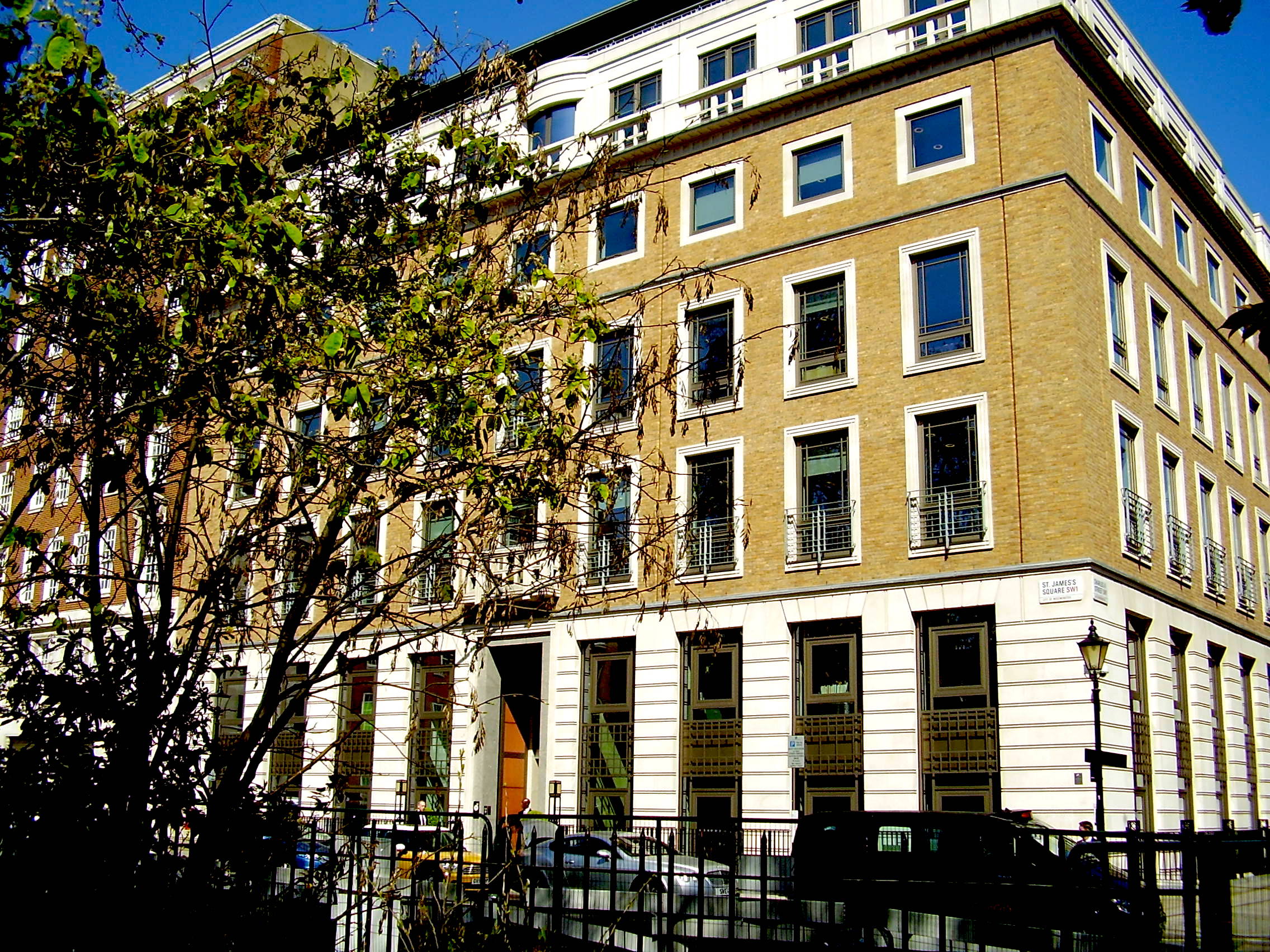
The head office of BP in London. (WhisperToMe, Public Domain, Wikimedia Commons)
Data obtained by Declassified through the Freedom of Information Act indicates how the Foreign Office has facilitated Shell and BP’s return to Venezuela.
Executives from the companies met with Colin Dick, Britain’s chargé d’affaires in Caracas, eight times in the two months following Maduro’s kidnapping, compared with eight meetings for all of 2025.
While the Foreign Office has refused to disclose what was discussed beyond a few heavily redacted emails, the frequency of the meetings might be seen as implicit endorsement for the energy giants’ new ventures in Venezuela.
Oil has been guiding British foreign policy in Venezuela for over a century. Former Foreign Minister for the Americas Alan Duncan declared in 2018:
“The revival of the oil industry will be an essential element in any recovery, and I can imagine that British companies like Shell and BP will want to be part of it.”
Britain’s current director for the Americas, Harriet Thompson, was in Caracas in early March 2026 as Shell was gearing up to sign major new energy deals.
Thompson “conducted a productive visit that included meetings at the Venezuelan Foreign Ministry and engagements with representatives of British companies to explore growth opportunities for both countries,” the embassy said.
When asked in Parliament whether those talks involved British natural resource companies, the Foreign Office said the question had already been answered in January — two months before the meetings had even taken place.
In its own write-up, the Venezuelan government said the delegation was the first of its kind for years, and opened new routes for “trade exchange” within a broader goal of “strengthening cooperation in strategic sectors.”
Earlier this month, Venezuela’s Foreign Minister and former Ambassador to the UK Félix Plasencia and National Assembly President Jorge Rodríguez, Delcy’s brother, were in London for another high-level diplomatic exchange.
Standing outside the Foreign Office, Rodríguez noted how the meetings with British diplomats had covered “oil and gas investments” and the “rapid economic growth of Venezuela.”
‘Plundering’

BP gas pumps in North Carolina in 2023. (Harrison Keely / Wikimedia Commons/ CC BY 4.0)
BP and Shell have also been busy lobbying on Venezuela in Washington after a long period of relative dormancy.
Their efforts have focused on convincing the U.S. Office of Foreign Assets Control (OFAC) to give them licences to operate in Venezuela as the Trump administration eases sanctions for projects which benefit US oil interests.
In the first quarter of 2026, Shell registered lobbying activities worth $1.3 million in the U.S. which involved “the commercial development of natural gas in the Dragon gas field offshore Venezuela and Trinidad and Tobago pursuant to a licence issued by OFAC.”
During the same period, BP registered $1.18 million in U.S. lobbying activities which included a focus on “Venezuela and OFAC licensing.”
Shell’s CEO Wael Sawan even met with Trump in January, saying he was “ready to go” with “a few billion dollars’ worth of opportunities to invest” in Venezuela.
Days later, U.S. lawmakers implored Sawan and other oil executives “to decline to participate in any transaction or arrangement that relies on the Trump Administration’s asserted authority to control Venezuelan oil assets.”
Ricardo Vaz, lead editor of Venezuela Analysis, told Declassified: “Much like it joined the U.S. in its economic blockade, the U.K. and U.K.-headquartered corporations are determined not to miss out on the plundering of Venezuela’s natural resources in this post-January 3 context.
“BP and Shell have been on the frontlines to take advantage of the reformed energy sector and feature among the six corporations that received the first general licence to negotiate deals with the Venezuelan government.
“Both companies had an extensive operational history in Venezuela’s oil industry, and they will now arguably return in the most favourable conditions they have ever enjoyed.”
Diplomatic Rapprochement
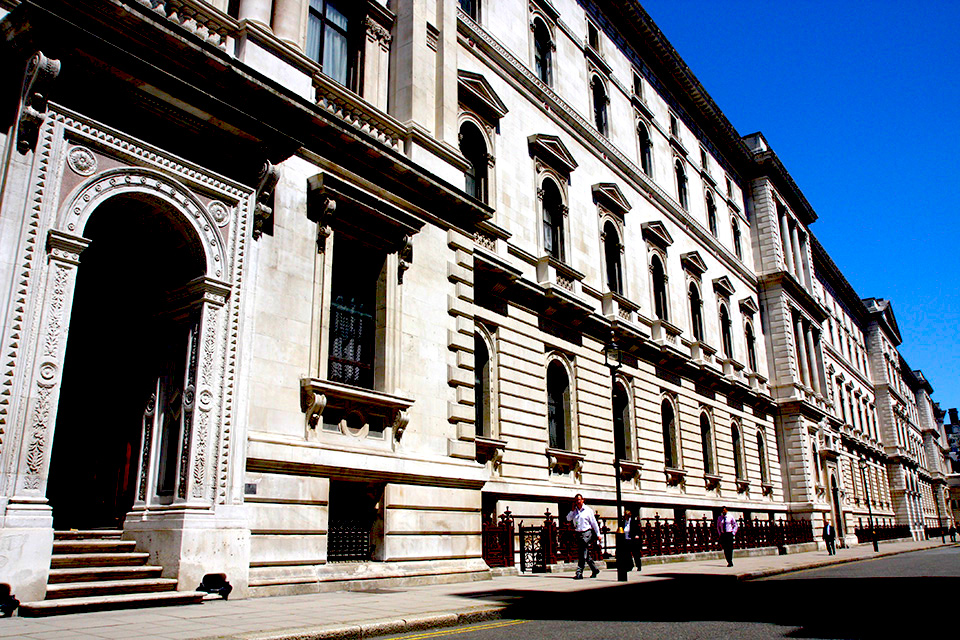
U.K. Foreign Office in London. (Foreign and Commonwealth Office, CC BY 2.0, Wikimedia Commons)
The improved position of BP and Shell in Venezuela has coincided with a significant diplomatic rapprochement between London and Caracas.
Under Maduro, the U.K. government insisted fresh elections were necessary before diplomatic normalisation, but the position has now been reversed, with the Foreign Office saying a democratic transition requires improved diplomatic relations.
“Upgrading our relations will strengthen our ability to play a constructive role in support of a democratic transition” and “promote U.K. businesses in Venezuela,” Foreign Minister Chris Elmore said earlier this month.
This “upgrade,” he said, would pave the way for the appointment of a U.K. ambassador in Caracas for the first time since 2017.
To celebrate this new spring in the U.K.-Venezuela partnership, Delcy Rodríguez met with Britain’s Chargé d’Affaires Colin Dick in Caracas on Sept. 18. The pair were filmed laughing together as they fed deer and admired peacocks.
“Venezuela and the United Kingdom are opening a new chapter in their bilateral relations,” beamed Rodríguez.
The Frozen Gold
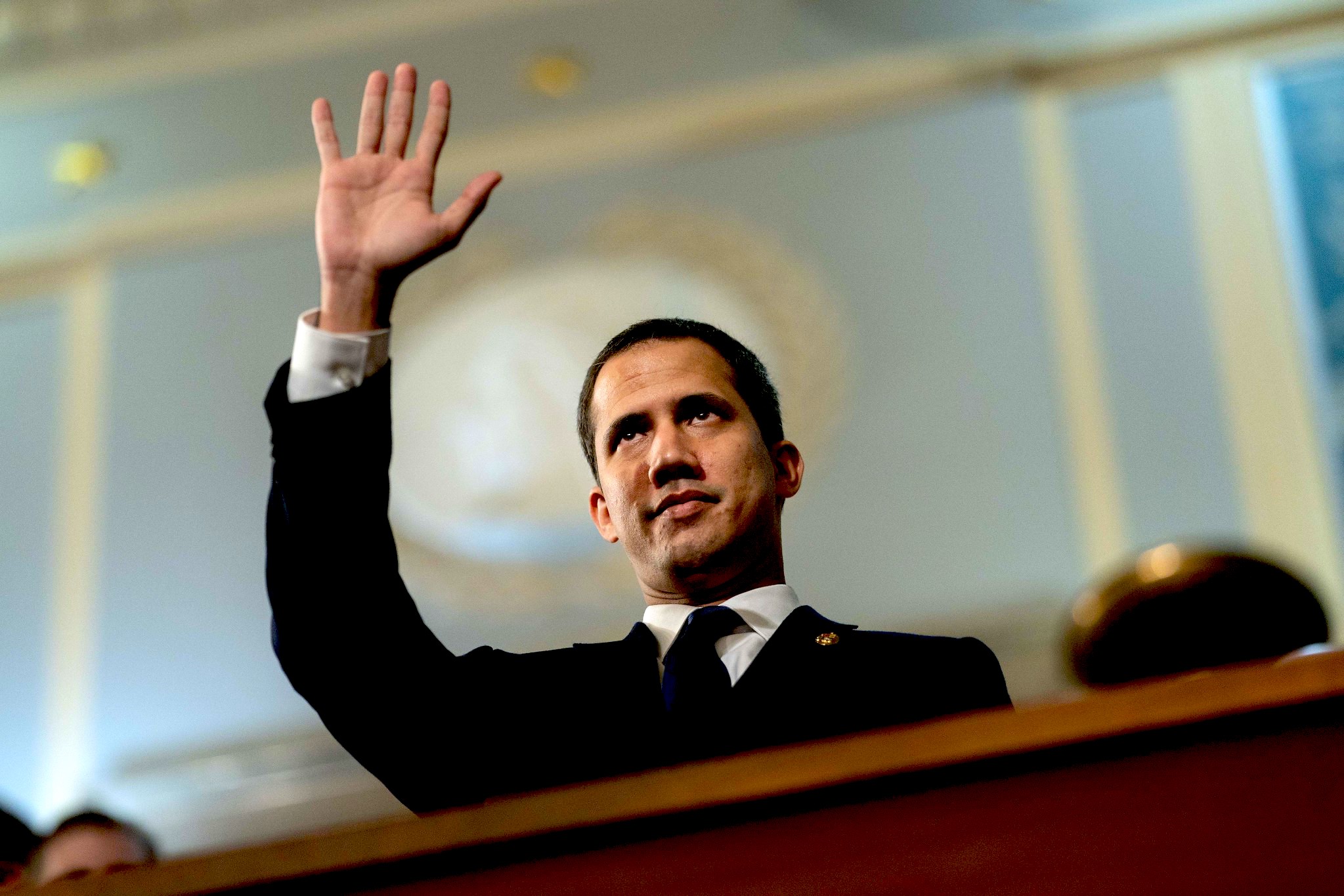
Feb. 4, 2020: Juan Guaido after being recognized by President Donald Trump as the legitimate leader of Venezuela during the State of the Union address at the U.S. Capitol in Washington, D.C. (White House, D. Myles Cullen)
One of Venezuela’s top priorities amid the improvement of diplomatic relations will be the return of roughly $4 billion of gold that has been frozen in the Bank of England for over seven years.
While Elmore said Britain’s “long-standing position is to recognise states, not governments,” it was the U.K. government’s decision to recognise a parallel government under Venezuelan opposition figure Juan Guaidó in 2019 that fomented the gold deadlock.
According to former U.S. National Security Adviser John Bolton, then Foreign Secretary Jeremy Hunt was “delighted” to help with Washington’s destabilisation campaign in Venezuela, “for example freezing Venezuelan gold deposits in the Bank of England.”
After a protracted legal battle over ownership of the assets, Guaidó was ousted and his parallel government dissolved in 2022 — but the gold remained frozen due to Britain’s enduring non-recognition of Maduro.
The Rodríguez administration and the Venezuelan opposition have since engaged in negotiations, with both sides reportedly agreeing that the gold should be released.
These negotiations, according to the Financial Times, might result in the gold being transferred from the Bank of England to the Federal Reserve of New York, with the assets only available as collateral for government borrowing rather than for sale.
Transferring the gold to the country whose leader orchestrated the kidnapping of Venezuela’s head of state — after freezing the gold amid concerns about democratic legitimacy — might raise awkward questions for the Foreign Office and the Bank of England.
A spokesperson for the Bank of England previously said:
“The Bank is not in a position to act on instructions until there is a further order from the U.K. Court which makes clear who has legal authority over the account. This requires the parties involved in the case to approach the U.K. Court to settle the dispute.”
The Foreign Office, BP and Shell were approached for comment.
Ana Maria Monjardino is an independent writer and journalist whose work focuses on Latin America and Palestine. She has written about the Palestinian diaspora in Latin America and Israel’s military history in the region. She has also covered the growth of Christian Zionism.
John McEvoy is chief reporter for Declassified UK. John is an historian and filmmaker whose work focuses on British foreign policy and Latin America. His PhD was on Britain’s Secret Wars in Colombia between 1948 and 2009, and he is currently working on a documentary about Britain’s role in the rise of Augusto Pinochet.
This article is from Declassified UK.
Views expressed in this article may or may not reflect those of Consortium News.
The Spanish Armada was an anti-piracy mission aimed at the Pirate Queen Lizzie and her Pirate Captains. What you say has been true for centuries.
Americans don’t realize this because Americans’ little knowledge of history comes from the lying British perspective which of course turns black into white and down into up and claims that the Brits have always fought for democracy and freedom. All while ‘civilizing the natives’, and stealing the gold and diamonds, and selling opium to the Chinese, and committing any other crimes that give them wealth and power — but hey, its ok, because its all being done by the Brits.
America had a much better perspective on the nature of the Brits in 1780.
The spoils are spoiling of international law for defenseless country and spoiling the western military exploits of taking soiling lands across the world by the military system born of Roman and Viking raider systems.
The interesting part of this comment is that the UK is a defenseless country. Read a few reports about the state of the UK military. They can’t fight their way out of a paper bag. Most of their navy can’t get out of port. Like the US military, they mainly seem good at committing atrocities against civilians. The big joke is that they seem to want a war with Russia. Frankly, I kinda hope they get it as it won’t go any better for them than their attempts to fight off invading Romans, Vikings or French who walked into a defenseless England and made it their home.
Unfortunately they still have the weapon of most mass destruction – nukes. Although their military is unable to do much, as long as those launchers are still operational they keep swinging their prick around the globe.
The world is threatened by a gang of armed murderous thugs. If there is not a serious attempt to bring them to justice for their many crimes, they will destroy the only livable habitat we have. As journalist Abby Martin has said, “we are not nearly angry enough.”
“To the victor belong the spoils” is the Law of The Jungle. The people who like the jungle living so much, we should find ’em an island some where they can practice dominating each other and leave the rest of us in peace and diplomacy. They can bomb the hell out of each other.
The island is a very good idea.
Yet, they should only get very primitive weapons, so they cannot ruin the environment too much.
The mass murdering thieves still holding the brutally kidnapped and still legitimate President of Venezuela Mr. Maduro and(!) his wife locked up hostage.
And it looks like no one in power from the western and even eastern countries, neither the UN is asking the criminals to immediately release Mr. and Mrs. Maduro!??
And yes, it virtually is an outright plunder of the people of Venezuela, with a gun pointed at their head.
Including of course Mrs. Rodriguez, independent of what she may (be obliged to) demonstrate publicly.
She and her administration likely is doing her very best to avoid the worst.
If you turn off the American news, you can find that both China and Russia have condemned the illegal kidnapping of a nation’s leader, and done so quite strongly. But, in America, nobody gets to hear what these nations say. IIRC, FM Lavrov made that point in his recent UN speech, which of course was not heard in America.
The interesting news is that under the “Turn Abouts is Fair Play” legal doctrine, it is now ok for any other nation to kidnap leaders of America (and their wives) and put them on trial for gangsterism, corruption and the tortures committed by their forces. Donald Trump has now established this as a precedent to any in the world who do not accept that America gets to work by one set of rules and everyone else has to follow another set.
One can never know what transpires in the shadows, but it appears obvious that Rodriguez has accepted large bribes from the Yankees. She is following orders, and never provides any resistance.
In Iran, there were reports that came out that the Yankees had also been offering large bribes to the leaders of Iran to get them to turn traitor. This was after the assassinations that began the war, and the Yankees thought that they could bribe the leaders assuming power. It was reported that this had worked in Venezuela, so the Americans expected it to work in Iran. Turns out the Iranian leaders were made of sterner stuff.
The question is does a leader stand up to the big bully, possibly with risk to their own safety? Or does a leader knuckle under and follow orders and accept the bribes? It is obvious which course the leader of Venezuela has taken. She sure as heck didn’t take up Chavez/Maduro’s struggle, which is what the people who elected her as Vice President probably expected.
An excellently relevant comment to the eye-opening piece by both the authors of the inspiring original article. Cross-referencing the Venezuelan leadership’s seeming dilemma with that faced by the more spineful Iranian experience is particularly welcome. Actually, Delcy Rodriguez’s “gender-equalised” political supplantation of Maduro fits the larger pattern of globalizing imperialism’s ongoing trend of proping-up women leaders across the world to facilitate resistenceless exploitation of natural resources by otherwise highly nationalistic leaderships within Global South. Imperialists have discovered that manipulating emerging polities from within women’s petticoats are far more realistic and fruitful in many regions. Vijay Prasad has similarly brought out wonderfully the larger dynamics at work in his regional perspective of Latin America in his piece for Consortium News’ October offerings. Still, Delcy is no ordinary political bimbo, she comes ready with some able dicks up her own sleeves to give the “Donroe Doctrine” some varied thrusts down the line. So, the British partaking in this U.S. ravish of Latin American natural resources would be exposed to some latent challenges as Trump proceeds to his mid-term and beyond.
Our world order
bully takes
the rest suffer
on steroids
nothing new
just
in your face
world
A brief review of the past frw centuries quickly underlines that the majority of the wealth of Britain and many of it’s major corporations, was stolen at the barrel of a gun or cannon, whether slavery or the colonization of entire countries based on treaties signed under duress of invasion and even by kidnapped leaders.
What happened to Maduro and Venezuela is pretty much the entire story of British empire in Africa for example.