The global war on terror, born from the ashes of the twin towers, perpetuates itself by constantly seeking new targets, writes Manuel Tufró.
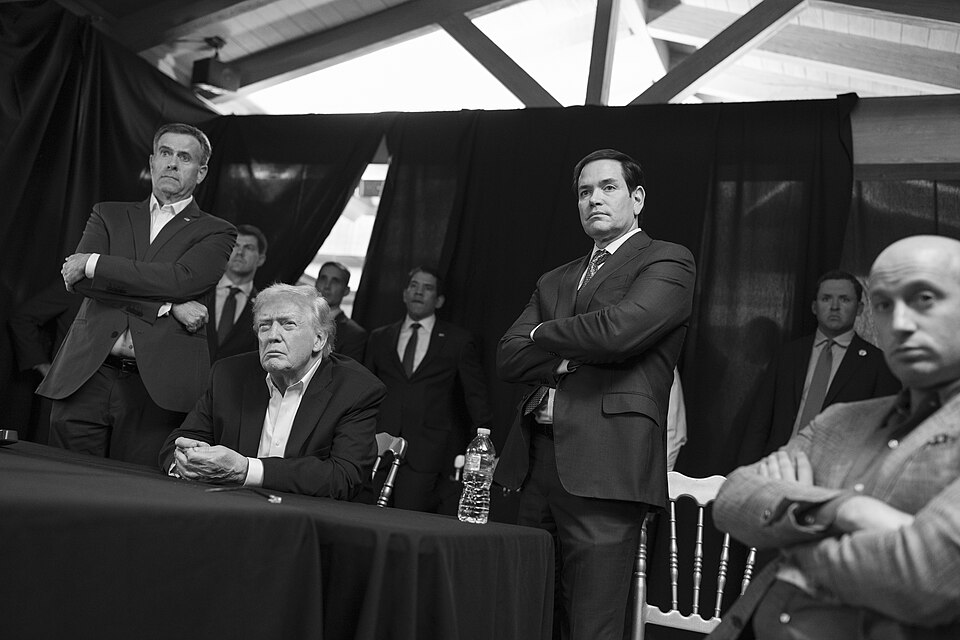
President Donald Trump, C.I.A. Director John Ratcliffe, Secretary of State Marco Rubio and Deputy Chief of Staff Stephen Miller monitor U.S. military operations in Venezuela, January 2026. (Official White House Photo by Molly Riley)
By Manuel Tufró
Open Democracy
Twenty-five years ago, four simultaneous suicide attacks on U.S. soil claimed 2,977 lives. Most of the victims were people who worked in the World Trade Center’s twin towers. Hundreds of firefighters and police officers who rushed to the disaster site also died.
The trauma of the attack on American soil entrenched in U.S. politics the idea that the response had to be on the scale of war. And so it was: a global and endless war ensued, one that to this day perpetuates itself by constantly seeking new targets. It involved the invasion of several countries, the normalization of torture, and the detention of hundreds of people in secret prisons scattered throughout the world.
According to Brown University’s Costs of War project, more than 900,000 people died as a direct result of the war on terrorism in the twenty years following the attacks of Sept. 11, 2001. “Indirect” deaths caused by the collapse of the infrastructure and economies of the invaded countries are estimated at around 3.8 million people.
The current situation in Latin America redefines this date as the starting point of another aspect of the process – one that is perhaps less discussed in our region: the reconfiguration of states, their laws, institutions, practices, and balances of power, all geared toward combating terrorism as the supreme objective. The anti-terrorist state was born. And once it was set in motion, it could never be dismantled. What was built under the pretext of an exceptional situation became the norm.
In the United States, it was decided that terrorism required a military response externally, but also a reconfiguration of the state internally. Activities such as emergency response and immigration control were “securitized” and placed under the purview of a new Department of Homeland Security, created in 2002. The authority granted to intelligence agencies to collect all types of data to spy on the population itself was expanded.
End of Due Process and International Law
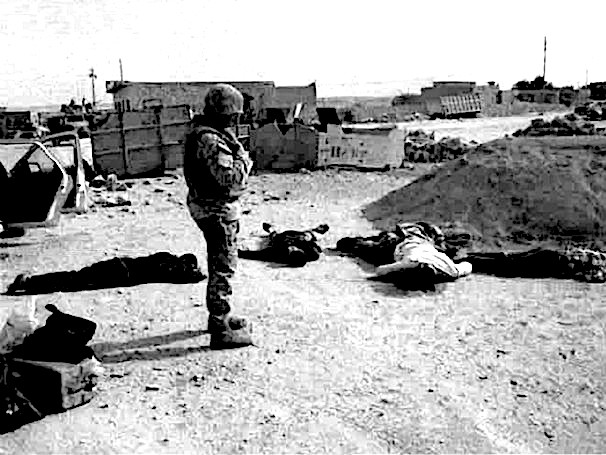
A U.S. Marine inspecting a roadside scene near Haditha, Iraq, where five unarmed civilians were killed on Nov. 19, 2005. (Unknown U.S. Marines and the Naval Criminal Investigative Service via The Washington Post, Wikimedia Commons, Public Domain)
In terms of national and international law, the blurring of the line between criminal justice and the laws of war — coupled with an increasing emphasis on prevention and anticipation — led to a sort of parallel legal system with no right to a defense and no means of overseeing the proceedings.
A series of administrative tools based on the logic of labeling were also developed: all the state has to do is label a person or organization as a terrorist for them to face consequences without the need to present evidence or go through legal proceedings. This is how, for example, the various “lists” of designated terrorists work, from which severe sanctions are imposed on the individuals or groups included on them.
In the years following 2001, the idea that the fight against terrorism must be carried out using militarized and exceptional measures became the norm globally. This occurred because other countries, such as Russia, China, and Israel, found in this counterterrorism framework an opportunity to legitimize their actions against internal and external enemies.
“All the state has to do is label a person or organization as a terrorist for them to face consequences without the need to present evidence or go through legal proceedings.”
A global counterterrorism architecture was also established at the U.N. level, based on four pillars: addressing the conditions that foster the spread of terrorism; preventing and combating terrorism; strengthening the capacities of states and the U.N. itself for that purpose; and, finally, ensuring respect for human rights and the rule of law in the context of the fight against terrorism. It will come as no surprise to anyone that interest in enforcing the fourth pillar was, and remains, scant or nonexistent.
Latin America remained largely on the sidelines of this trend, except in cases such as Colombia, where the approach to the internal conflict was also at times viewed as part of the global war on terrorism.
But the exceptional status of the Latin American “zone of peace” began to change in recent years. First, a number of governments in the region began to take an interest in applying the counterterrorism framework domestically. The persistence and evolution of organized crime provided the perfect excuse. Militarization, states of emergency that allow bypassing the separation of powers, and the consolidation of secrecy as a form of governance are all measures far too appealing to leaders with authoritarian tendencies.
Trump Targets Latin America
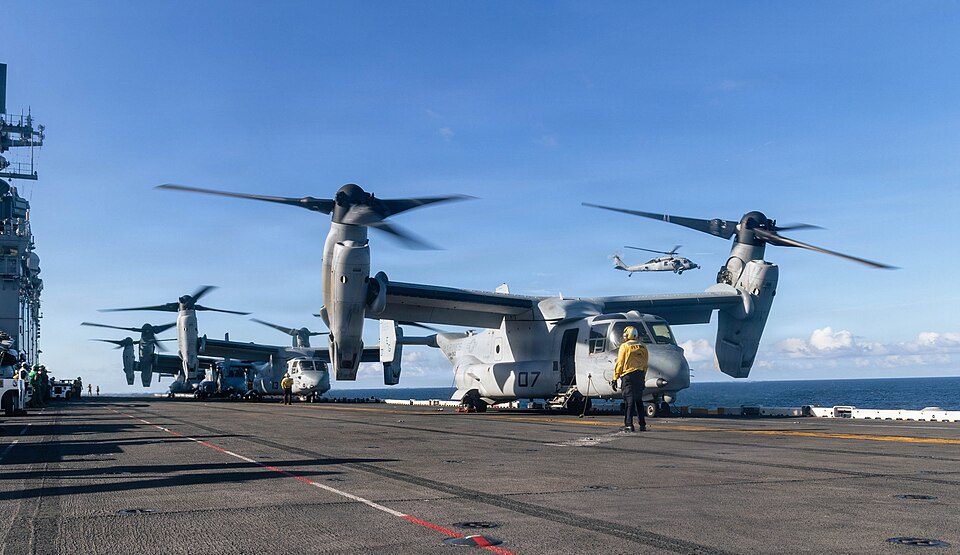
MV-22B Ospreys aboard the USS Iwo Jima during Operation Southern Spear in preparation for action in Latin America, October 2025. (US Marine Corps)
Thus, the counterterrorism framework also began to shape several Latin American states — El Salvador, Ecuador, Honduras, Peru — with the sequence of events almost always the same. Real instances of violence establish the use of the category “terrorism” and legitimize emergency measures; once in place, these measures become entrenched and normalized and begin to be used for the purposes of political persecution. Other countries with much lower levels of violence, such as Argentina and Chile, have spent several years attempting to label territorial conflicts involving indigenous peoples — such as the Mapuche — as terrorism. With the advent of far-right governments, they are also taking measures to reconfigure the state along the anti-terrorist lines.
This trend was exacerbated by Trump’s return to power. As part of its new global strategy, the U.S. defines Latin America as a zone of exclusive dominance.
The current plan is to mobilize the entire continent toward a process of militarization subordinate to the Southern Command, using the fight against “narco-terrorism” as a pretext. To this end, it is reviving and updating many of the tools from the post-2001 anti-terrorism framework.
Consequently, Latin American strategies that abuse the anti-terrorism framework are being emboldened because the U.S. promotes the application of that same framework as a hemispheric policy, in addition to using it domestically. Even the broadening of the definition of terrorism to include political persecution was explicitly promoted by Secretary of State Marco Rubio at the recent “summit” that brought together representatives from more than 60 countries to hear his warnings about the “resurgence of leftist terrorism.”
Twenty-five years after the launch of the anti-terrorist state, its shadow looms larger than ever in Latin America, exacerbating the risks of an escalation of lethal violence, recurring violations of national sovereignty with the consent of local elites, and political persecution disguised as counterterrorism.
The concept of terrorism establishes a link between politics and crime. Today this allows governments to criminalize dissent, especially those who attempt to resist current forms of subjugation (genocide, environmental destruction, impoverishment, right-wing political violence) through forms of direct action. As Argentinian scholar Pilar Calveiro pointed out in her book Violencias de Estado (State Violence), these forms of collective action ultimately refer to the “right to rebellion” – a right once recognized – which the counterterrorism framework seeks to eradicate.
Resisting the anti-terrorism framework’s ability to reshape the functioning of the state (and parts of society) in an authoritarian and violent direction is now a political priority for civil society, social movements, and democratic forces in Latin America.
Manuel Tufró is coordinator of the Democratic Security and Institutional Violence Team at the Center for Legal and Social Studies (CELS), a national human rights organization in Argentina that has a regional and international agenda.
This article is from Open Democracy.
Views expressed in this article may or may not reflect those of Consortium News.
Please Donate to
CN’s Summer
Fund Drive!


A mass murderous (giant) business for the few.
Those profiting must be clearly and personally identified, exposed and held accountable!
The government’s sold you out. Just like up here in America.
The substantive gist of this revealing article by Tufro on the hemispheric creep of the U.S.’ now seemingly truncated anti-terrorism mission is nicely captured in his third last paragraph within the following GOLDEN CLAUSE : “… POLITICAL PERSECUTION disguised as counterterrorism” ! This is also the realpolitik reality that, unforrunately, applies across the board in most countries in the rest of the world, with or without any Trumpian America’s overt involvement .
PS . . . . long before we had 9-11 and the War on Terror, we had the democratically elected President Allende in Argentina being violently overthrown and murdered by General Pinochet. This was fully backed by the USA. Specifically by names like President “Tricky Dick” Nixon and his war criminal advisor Henry Kissinger. There is a long, long history of this throughout Central and South America. This did not begin with the War on Terror.
‘Yankee Go Home’ was not first written on a wall after 9-11. It is much older than that.
‘War is a Racket’ by General Smedley Butler, was written after his long service of putting down people’s revolts south of the USA’s border. That book is nearing its 100 birthday.
Kudos for your brief corrective. Nixon was one of the very few scholar-presidents that the U.S. was lucky to have and can quite rightly be proud of. I didn’t know that Nixon had “Tricky Dick” for a nickname, though. Regardless, many dictators and even some DICKtators across the world kept regular counsel with him and especially treasured their intimate rapport with his Secretary of State Henry Kissinger whom you chose to bill as a “war criminal”.
OMG, this author thinks that everything was perfect before 9-11, and it is only the bi-partisan War on Terror that began being a problem after 9-11. Yikes.
This military-police state grew to power during WW2. After WW2, it began to seriously subvert democracy at home. It had never supported Democracy in ‘the Americas’. At least not much after President Monroe. At home, after WW2, we had McCarthyism and the blacklists and censorship. Under JFK, the American capitalists began to re-organize the fight against people’s revolts south of the border. We had the rise of ‘counter-insurgency’, and the formation of institutions like the School of the Americas. We had the hundreds of attempts to assassinate Castro, and overthrow that people’s government. We had a massive effort to make sure that this did not spread to other people. We killed Che in the 60’s. All through the later half of the 20th century, we had American imperialism supporting murderous dictators in order to defeat the ‘dang commies.’
None of this is new. None of this began with 9-11. This did not begin with Trump, no matter how much people want to pump this stuff out for ‘the midterms.’
The exclusive dominance is that of permanent credibility of western civilization as dominated over time by a self created fantasy of a god created to give us permission for everything we want like Santa Claus that never give out coal but just hands out gold and silverware.
With all due respect to the author, I am not sure that I would frame the rise of an “anti-terror state” in Latin America during the twenty-first century, particularly the 2020s, as a “capture” so much as a “reassertion.” It certainly is not something that is without precedent in Latin America even prior to the GWOT-oriented “Plan Colombia” from the 2000s onward, as the often brutal counterterrorism/counterinsurgency campaigns waged by states such as Peru under civilian authoritarian governments in the 1980s and 1990s (and even previously in the mid-1960s), Argentina under both civilian and military governments in the 1970s, and myriad other military governments aligned with “Operation Condor” and “Operation Charly” during the Cold War can attest.
You have my ditto.
I’d refer to the recent attacks by US imperialism in Latin America as US imperialism in Latin America 2.0. As someone who has worked in solidarity with liberation movements and those that are successful in taking power for the past 40 years what the US is currently doing is not new.
It’s best to not assume that all readers will know what terms like the Southern Command refer to. It would take very few additional words to make sure this piece is as accessible to as many people as possible.
Interesting that people do not know the structure of the American military proconsuls that divide the world into areas to be ruled. Southern Command is the General, and the trained killers under their command, tasked with controlling the people south of the USA’s southern border. Northern Command is the General who controls the people north of the USA’s southern border.
Then again, people probably do not know enough history to know the old Roman term ‘proconsul.’ Thus, I suppose more explanation is always needed.