The road to fascism, as Ece Temelkuran writes in Nation of Strangers, was constructed over the last six decades of neoliberal assault. We have arrived at the terminus.
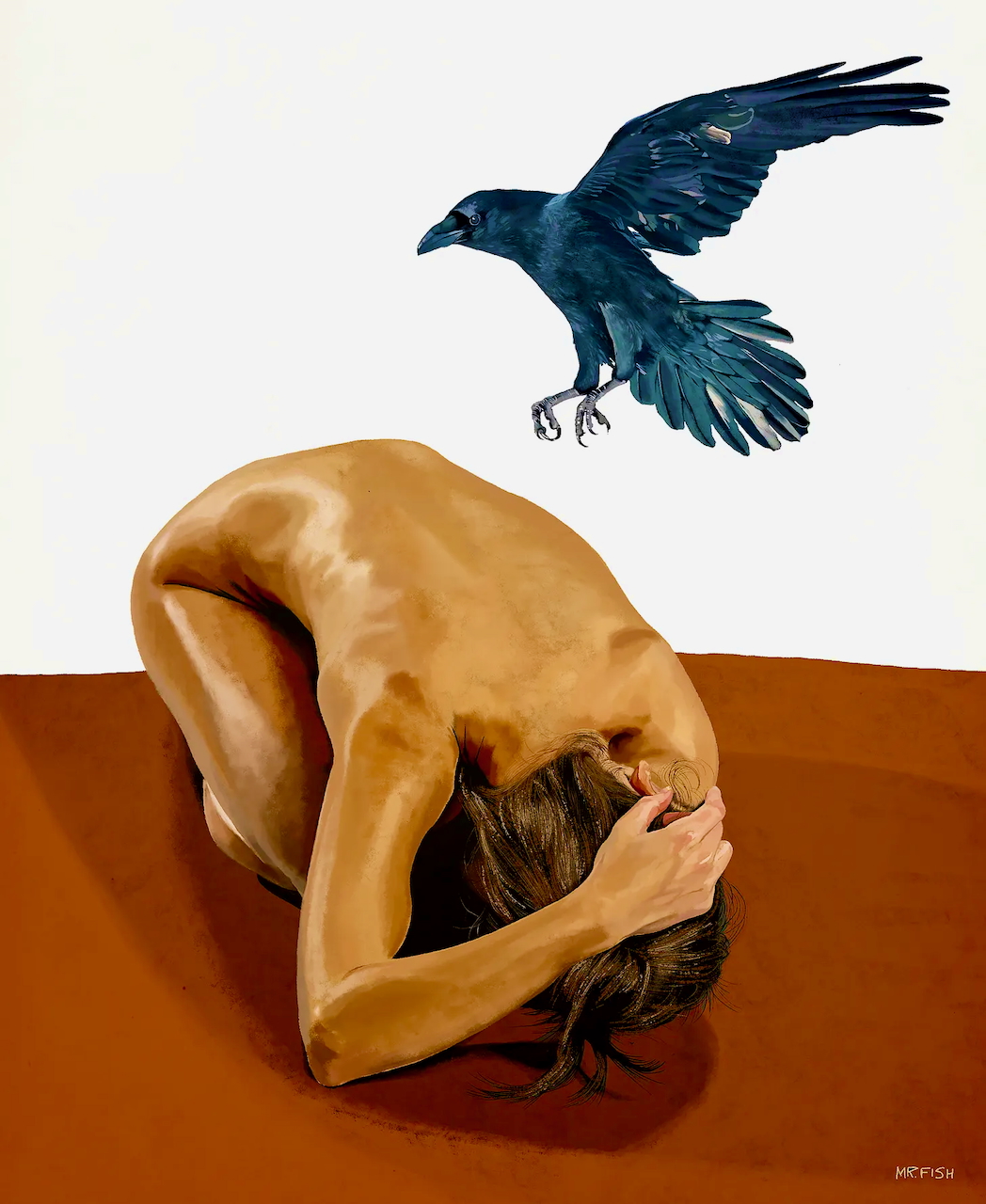
Becoming the Stranger by Mr. Fish.
 We are becoming strangers. Strangers in our own countries. Strangers in the world.
The values we cherish, the liberties we once took for granted and the possibility of a democratic future are vanishing. The communities where we found meaning and purpose are being demolished.
The iron grip of fascism is being consolidated. The decades-long assault on democratic institutions in the name of neoliberalism, better understood by its less sanitized name, cutthroat capitalism, is reaping its grim harvest.
Ece Temelkuran in Nation of Strangers: Rebuilding Home in the 21st Century draws on her exile from Turkey, as she did in her previous book, How to Lose a Country: The 7 Steps from Democracy to Dictatorship, to prepare us for a future we do not want but will be forced to endure.
Nation of Strangers is written as a series of forty letters beginning in June 2022 and ending in April 2025. Each letter is addressed “Dear Stranger,” which slowly drives home the point that we will soon become, like her, a stranger. First in our own land, then, for some of us, in exile.
She scoffs at our mania for hope, the naïve belief that our hollowed out and corrupted institutions can roll back the fascist tide.
“I don’t believe in hope,” she writes, “but in determination, having faith and doing what you can to survive when there is no hope.”
Temelkuran was a prominent Turkish novelist essayist, and journalist. She wrote a widely read column and had a show on national television. She was also the bête noire of the government of Recep Tayyip Erdogan, especially after the publication of her 2016 book Turkey: The Insane and the Melancholy.
She left Turkey after being relentlessly smeared and attacked by government-run media, her colleagues started to be imprisoned, the death threats became “too regular to ignore,” and she lost her job.
Temelkuran called her mother on Nov. 6, 2016, from Zagreb, Croatia: “Mom, I am not coming back home.”
“It was a one-minute phone call,” she explains. “Half of it was silence. But that’s all it took for me, in the autumn of 2016, to become homeless.”
She was 43.
You can see my interview with Temelkuran here.
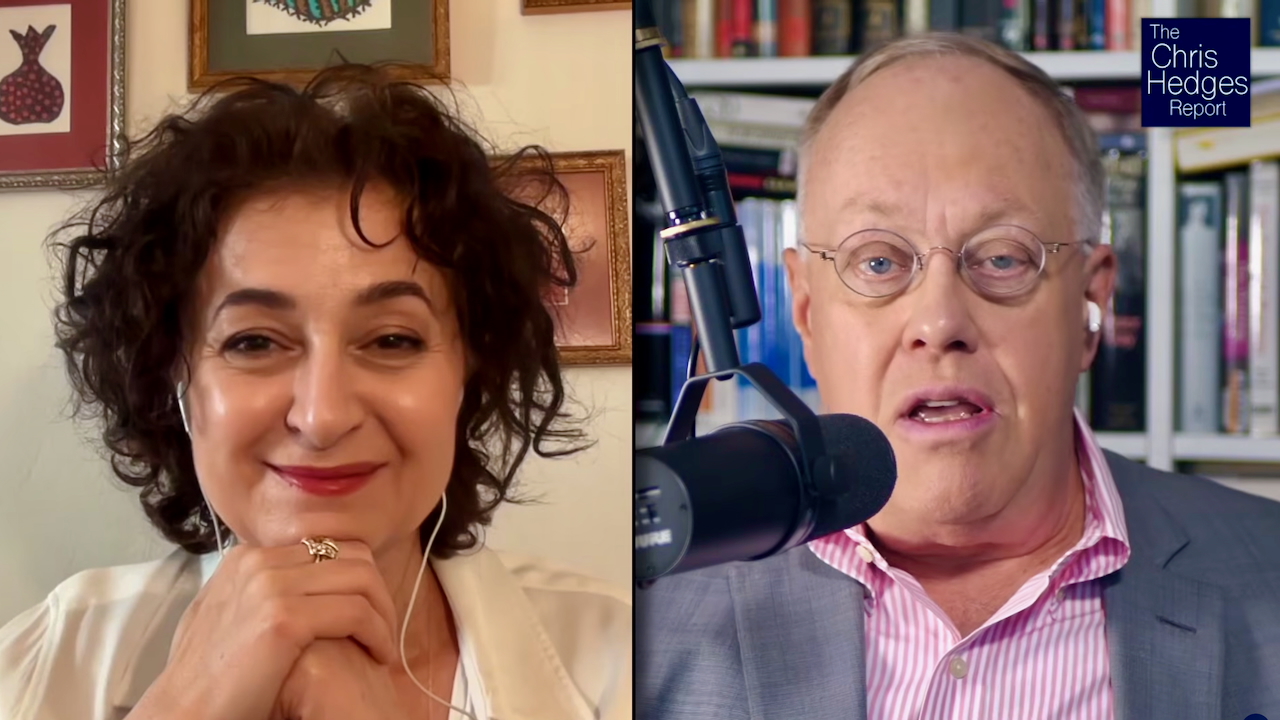
Temelkuran and Chris Hedges (The Chris Hedges Report)
“The neoliberal system’s reality — extreme inequality — cancels out the fundamental promise of democracy — equality — and that is why the idea of protecting democracy means less and less to people,” she writes.
We are rendered homeless not only because of those who hold power, whether it be Vladimir Putin, Narendra Modi, Benjamin Netanyahu, Donald Trump, or Erdogan, but because of a bankrupt liberalism, a faux opposition enslaved to the same corporate and oligarchic masters.
“Since our political outrage is considered irrelevant by the conventional homes of realpolitik, the old political parties, we find ourselves politically homeless, too,” Temelkuran notes.
“We no longer know through which political medium we can unite our voices to be heard by the rulers. Like refugees, we stay in temporary places: protest tents, makeshift occupy-movement tents or strike marquees. In the cold or under the sun, we imagine and reimagine a new political home — like an exile who knows that the old home is impossible to return to but still misses a home.”
Fascism’s lifeblood is the demonization of the other, of the stranger.
By 2050, over 1 billion people will find themselves “at threat of being displaced” due to “environmental change, conflict and civil unrest.” By 2070, between 1 and 3 billion people may find themselves “left outside the climate conditions that have served humanity well over the past 6,000 [years].”
She warns that the genocide in Gaza is a template for what will come, an exercise by the global ruling class to see how much carnage it can inflict with impunity.
Temelkuran describes Gaza as “a long bleeding, thick scar on the world map,” that is “widening to become a fatal gangrene, swallowing up the entire body of humanity.” She cautions that the “new standards of brutality will be set,” that “too many will become homeless by the end of this story, and it will not only be those whose houses are bombed. And it will all begin with the loss of one word.”
“There will be no explicit agreement needed,” she goes on, “but gradually, people will avoid that one word that is deemed ‘problematic’. It is the word genocide in Germany today; in other countries, it will be other words.”
The void left by the lost word
“will soon be filled with harmless words kindly suggested by the power-approved words, such as war, even though the other side is primarily civilians. Let’s not call it a genocide but ‘atrocities.’ Eventually, it will become impossible to join the public conversation without uttering only those approved words. They will operate as signal flares to show that you are not using the criminalized word. This is how fascism works. It not only silences people but also forces them to speak in a certain way.”
Temelkuran chronicles the indignities of surmounting bureaucratic obstacles to apply for residency and visa permits in “soul-sucking waiting rooms.”
She wonders, along with the other strangers, if, when the permit expires, it will be renewed or if she will be forced to find another refuge. She is hardened by exile. Humor is dark. She watches as refugees from the war in Ukraine arrive in Germany, clueless about what awaits them.
“The Ukrainians do not know this yet,” Temelkuran contends.
“They don’t doubt that the promise made to them by the Western world will be kept. They still believe that they’ll be welcomed in a civilized manner and taken in gracefully, dignity intact. A very dark, very broken place in me wants to laugh that repugnant laugh. You wish, baby! They never take you in without crushing you first. You will despise yourself, hate everything, give up, turn numb, and only then will everything start happening. You will be welcomed only when you surrender.”
Her experience as an exile mocks the West’s conception of itself.
“Westerners still like to think of Europe as the safe haven for the oppressed intellectuals of the Global South, but that is giving too much credit to Europa when thousands are pushed back into the sea to die,” she insists.
“Putting the spotlight on ‘the exile’ to divert from ‘the refugee’ operates as a crisis management tool, if not a branding strategy for Europe’s self-image.”
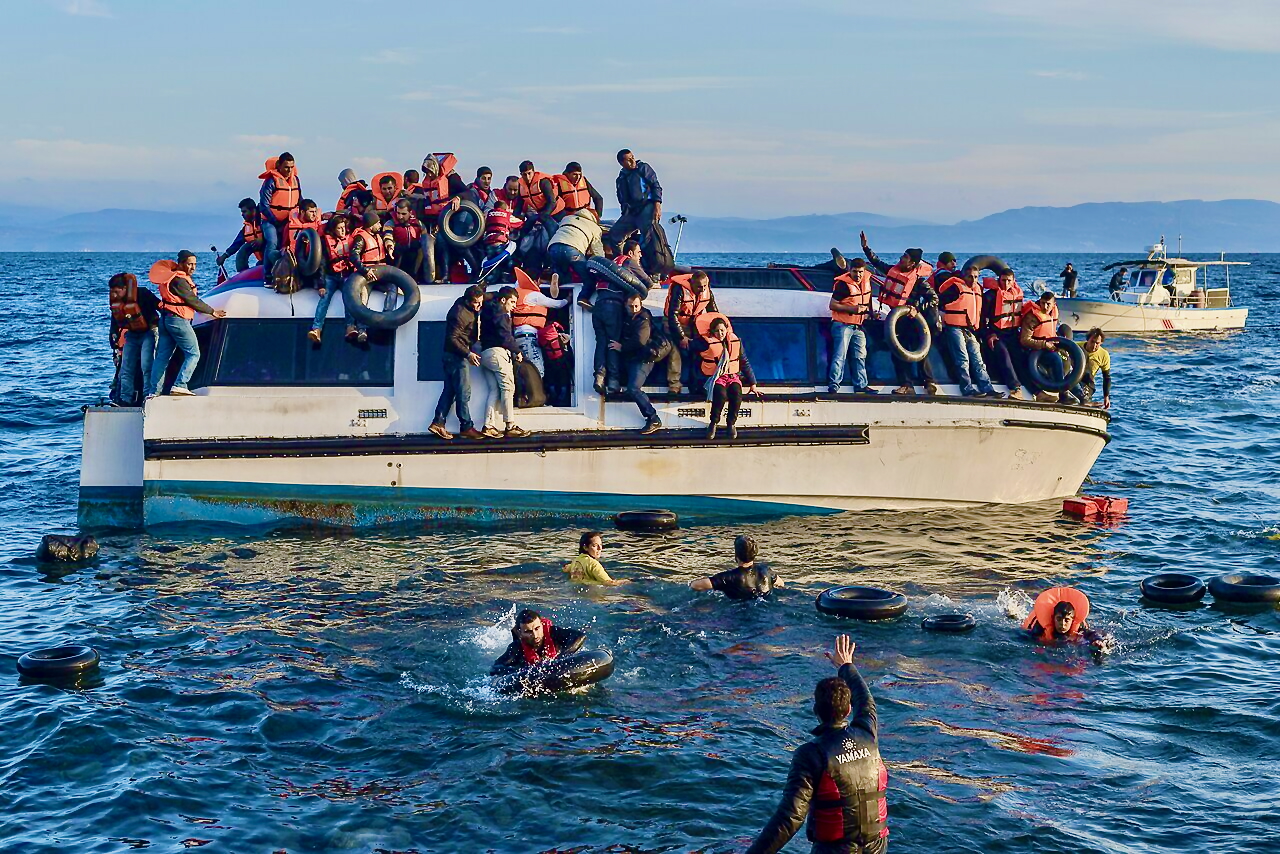
Syrian and Iraqi refugees arrive from Turkey to Skala Sykamias, Lesbos island, Greece in 2015. Volunteers from the Spanish NGO “Proactiva Open Arms” aid the refugees. (Ggia / Wikimedia Commons / CC BY-SA 4.0)
The persecution by the regime that drives the stranger into exile is not, ironically, the most difficult to digest.
“What the Westerners haven’t realized yet is that many of us do not leave our homes for fear of a dictator,” she writes.
“They still make the distinction in their heads between the ‘goodies’ and the ‘baddies.’ But what truly severs your ties to a country is to see so many people, ordinary people, supporting the regime even after witnessing its evil — to see so many choosing to be evil. That is when your faith in humanity shakes. That is what ostracizes us and makes us homeless even when we are at home — the sense of being under siege from inhumanity, madness and brutality.”
The final blow, Temelkuran says, the one that “actually breaks you,” does not come from “the other side.” Rather, it
“comes from those whom you think of as your people, your side. When the sense of defeat takes over the side you belong to, the anger or self-disgust of being on the losing side turns to self-hatred. The hatred turns people against each other, and then — as I did once before, permanently leaving the country — you find yourself under attack, more viciously than the other side can manage.
They say you are not enough. No cut is deeper than that. That is the precise moment when you become a total stranger in your home, when not the dictator but your fellow people sever your ties to your country.”
Home for “the abyss of the unhomed self” is no longer a place. It is not “a thing of the past or a destination to be arrived at in the future.” It is found in “these moments of being fully in myself, an intermittent sense of wholeness, a rare but precious feeling of normal people, and it will only be in the here and now.”
While the home we leave behind may be gone, there are “new homes in the making that yield moments of peace when you least expect them.”
That, perhaps, is a kind of hope, but one accompanied by eternal mourning and estrangement.
Chris Hedges is a Pulitzer Prize–winning journalist who was a foreign correspondent for 15 years for The New York Times, where he served as the Middle East bureau chief and Balkan bureau chief for the paper. He previously worked overseas for The Dallas Morning News, The Christian Science Monitor and NPR. He is the host of show The Chris Hedges Report.
This article is from Scheerpost.
NOTE TO READERS: There is now no way left for me to continue to write a weekly column for ScheerPost and produce my weekly television show without your help. The walls are closing in, with startling rapidity, on independent journalism, with the elites, including the Democratic Party elites, clamoring for more and more censorship. Please, if you can, sign up at chrishedges.substack.com so I can continue to post my Monday column on ScheerPost and produce my weekly television show, “The Chris Hedges Report.”
This interview is from Scheerpost, for which Chris Hedges writes a regular column. Click here to sign up for email alerts.
Views expressed in this interview may or may not reflect those of Consortium News.
Please Donate to
CN’s Summer
Fund Drive!

A very interesting article thank you.
“She [Temulkan] watches as refugees from the war in Ukraine arrive in Germany, clueless about what awaits them. “The Ukrainians do not know this yet,” The Ukrainians do not know this yet,” Temelkuran contends.”
I read only last week that some Polish people are now turning against the Ukranian refugees they initially welcomed so warmly. Especially those who have been successful in making a new life for themselves, opening small businesses for example.
I see some of this in France where I live. Initially welcomed but when the Ukrainian refugees became pro active in making a new life, things changed. I live in a very rural area and the refugees welcomed around here were generally young people. Absolutely no opportunities for them here so gradually moved nearer to larger cities and towns. Then accused of being ‘ungrateful’….
Denial of moral failure is central to the process of othering and ruthless aggression. If we are innocent or good it becomes easy to attack others who stand in the way of that goodness. Turkey continues to deny the Armenian Genocide, the US denies the war crimes in Vietnam, Iraq, Iran, etc. The British portray their imperial violence as a civilizing force, The BJP in India denies its murderous history. There are precious few places or peoples who have escaped this violence or othering of victims.
Humans will never evolve and may soon extinguish most life on earth if we cannot manage to break this cycle of denial and learn to seek harmony in the same way we have pursued conquest and dominance.
A useful and powerful commentary, but tarnished by the Putinphobia/Russophobia allusions of the first writer here. What other nation/leader so hinders the U.S. quest for world control, and whose quest commits such atrocities in doing so?
It amazes me that Charis Hedges characterizes Vladimir Putin as a despotic autocrat and by implication the Russian Federation as a fascist dictatorship.
Somewhere recently I read or heard someone say, “I can explain it to you, but I can’t understand it for you.” Having to say this to Chris Hedges, with his years of on-the-ground reporting from war zones, teaching in prisons, formidable education, ordination as a minister, numerous books — American Fascists is beyond great — I find incomprehensible.
Maybe someday he will come around.
Meanwhile, Chris Hedges’ position on “Putin!” ruins my experience of his journalism, which in the larger scheme of things does not matter but to me is an annoyance I wish I could correct
I agree.
I remember similar kind of “smearing” regarding Yugoslavia.
I find it interesting that Chris Hedges can’t let go of his Putin phobia yet Ray McGovern says we should thank our lucky stars that Putin has been the leader of Russia rather than some hothead from the military who thinks Putin is too patient with the provocations of NATO. I agree with Mr. McGovern.
I Agree. Putin is defending Russian speaking Ukrainians and now Russia itself from NATO aggression and Ukrainian fascist aggression against the Russian speaking oblasts and now against Russia itself, always the target. He is fighting fascism far more effectively than most. I have seen no evidence of him demonizing any group other than Banderite style fascists.
I agree with Lois and Ray McGovern and I believe Joe Lauria has said much the same and shown that Russia’s action is fundamentally defensive of Russia and Russian speaking Ukrainians, standing up against warlike NATO aggression. . Also Putin has expressed no hate for Ukrainians.
As to how easily we find ourselves othered when it comes to actually taking an un-compromised and unaffiliated stand against the kind of military aggression, war crimes and even blatant genocide we have seen in Vietnam, Iraq, Syria, and Gaza; the author is describing something troubling and far too common and at the deepest odds with the moral voices of human history.
Many people in my life expressed shock at the German people’s willingness to follow Hitler , as though this could never happen to them, when in fact every state, and every empire has the same tendency to expand their wealth and power with no regard for the humanity of those who will be injured and most people go along with national wars through that process of scapegoating which Ece is describing.
Chris Hedges seems to have accepted Timothy Snyder’s version of Russian history as authoritative — and Snyder’s incorrect inferences from it with regard to Vladimir Putin — as therefore valid, apparently without challenging Snyder’s methods or conclusions.
For example, in the written transcript of “A Discussion on the New Novel ‘Palaces of the Crow’ (w/ Ray Nayler)” at hxxps://chrishedges.substack.com/p/a-discussion-on-the-new-novel-palaces , Hedges directly quotes and references Snyder’s historical framing, writing: “Over a 12-year period, the Soviet and Nazi regimes killed 14 million people in an area that historian Timothy Snyder aptly names ‘The Bloodlands’.”
Snyder’s book “Bloodlands” has been widely criticized on numerous grounds:
hxxps://www.wsws.org/en/articles/2022/12/02/pnvx-d02.html
In his essay, “Restoring Lies and Insanity to American History” at hxxps://chrishedges.substack.com/p/restoring-lies-and-insanity-to-american , Hedges notes Snyder’s academic background, writing about him as “Yale scholar on authoritarianism, Timothy Snyder, author of ‘On Tyranny’ and ‘The Road to Unfreedom’.”
One of the most difficult challenges in scholarship is not only to open oneself to reconsider conclusions long burned into one’s foundational understanding, but to admit if necessary that one did not subject particular conclusions arrived at long ago to proper critical analysis.
Timothy Snyder, who is liberals’ and progressive Democrats’ go-to authority on Russian history, spins Russophobic narratives; and they tend among those audiences, which have limited exposure to less ideological Russian scholars, to go unchallenged.
Chris Hedges, for example, treats Snyder as an authoritative expert on Russian history.
The analysis linked to below (ame link as my comment above) explains many issues with Snyder’s interpretation of historical texts, mishandling of primary sources, and misrepresenting evidence to fit his conclusion — that the crimes of Nazism in Europe were a response to the crimes of Stalin in Soviet Ukraine in 1932-1933 — which on its face, to anyone who knows anything about Stalinism and Nazism, is absurd.
The Soviet famine of 1931-1933, during which 7 million people across the Soviet Union died of starvation, has far more in common with Mao’s Great Leap Forward from 1959 to 1962, during which 30 million people died of starvation, than it does, as Snyder claims, with the Nazi Holocaust.
This is because Stalin’s forced collectivization of agriculture, like Mao’s Great Leap Forward, was not undertaken to kill people. It was a bad idea, bureaucratically imposed, and not reversed in a timely fashion despite horrendous abuses, including rapes and murders, perpetrated by agents charged with enforcing quotas, not to mention mass starvation, because Stalin, like Mao, was convinced of the correctness of his thinking and that the outcome of this policy would be beneficial to his country.
The Nazis deliberately set out to exterminate Jews because they viewed these people as subhuman, evil, and undeserving to live; they murdered millions of mentally ill and disabled people, Sinti, Roma, and others whom they believed were genetically inferior and therefore also undeserving to live; and they murdered socialists and communists, whom they viewed as agents of Jewish treachery out to undermine Aryan unity.
Stalin’s Great Terror — one of the most horrific and complex chapters in modern history — was, as the Soviet scholar Vadim Rogovin defined it, a “political genocide.”
Read the article linked to below for a thorough analysis of the details. Suffice it to say here that Stalin, whose political ideology was centered on the notion of “socialism in one country,” set out to purge from the Soviet Union the so-called Left Opposition, which as I understand it included Marxists, Bolsheviks, Mensheviks, and others, all of whom were ideologically committed to “world socialism” or, in one way or another, permanent global worker’s revolution.
Obviously, murdering millions of people over this ideological disagreement is insane, but it is not fascism, and it is motivated by something entirely different from racially supremacist Nazi world domination.
Snyder seems to be taken seriously by audiences because he confirms the U.S.-U.K.-NATO-EU narrative promulgated by establishment media and Atlanticist think tanks that plucky, liberal, democratic Ukraine is defending itself today as it did in the 1940s against irredeemably intransigent “Russian aggression.”
To have narratives that are relentlessly pounded into the public’s minds confirmed by a so-called scholar whose work repeats again and again: “Those narratives are true! I am a professor at Yale. I have done the research. Believe me,” obviates the necessity to dig deeper and learn what is actually going on.
hxxps://www.wsws.org/en/articles/2022/12/02/pnvx-d02.html
I left the USA in 2003. Things are much worse there now. There are places in the world that are far better. There are some signs that the USAians can organize for change.
Thanks Chris. I felt less alone for a while after reading this. Wish I could share it on X with more than just a url.
You could easily live another 15 years.
Im 86.
I knew people that lived as long as 1l0 years
Excellent column.
Albert Camus and
Ryszard kapuscinski would likely agree.
I am glad I’m old (77). I won’t have to live under fascist rule for much longer. I never dreamed I would prefer death to life, but the coming dystopia is something I do not wish to see.
The world will not stop when you and I die but the suffering of the next generations are likely to increase so I see no comfort in looking forward to my own death
The same here. I am 83.