Downing Street persuaded Panorama to cut an exposé on the shooting of an unarmed boy in Derry in 1972, reports Anne Cadwallader.

Operation Motorman Mural in Derry, on Rossville Street, photographed in 2013. (Suzanne Mischyshyn / Wikimedia Commons / Creative Commons Attribution-ShareAlike 2.0)
By Anne Cadwallader
Declassified UK
 The very highest levels of the British government secretly exerted pressure on the BBC to censor a film about the army killing an unarmed child in 1972.
Official documents, recently discovered by the Pat Finucane Centre, also show the British Army was aware, shortly after the killing in Derry, that the boy had been killed at “point blank” range by an immensely powerful machine-gun.
However, the Ministry of Defence falsely informed an inquest into his death that he was shot from 25 meters away by a soldier who thought the boy was armed.
The case revolves around the shooting dead of 15-year-old Danny Hegarty during “Operation Motorman” in the early hours of July 31, 1972, as the British Army moved in to clear barricades and retake “no go” areas in the city that had previously been under IRA control.
A BBC Panorama reporter, Alan Hart (now deceased), had filmed people in Derry questioning the British Army’s account of how Hegarty was shot twice in the head and how his cousin accompanying him, Christopher, was wounded (another cousin, Thomas, was unscathed).
Pressure had begun mounting on the BBC after Hart had asked the British Army in Derry for an official response.
Hart had told the army how “everybody that he spoke to emphasised that it was impossible that the lad or his cousin…were carrying arms or explosives.”
He said Hegarty was from a “deeply religious Catholic family [who] have been actively preaching the Fifth Commandment — ‘Thou shalt not kill’ — and their peace overtures were well known.”
Hart’s request was referred to Donald Maitland, press secretary to the then prime minister, Edward Heath.
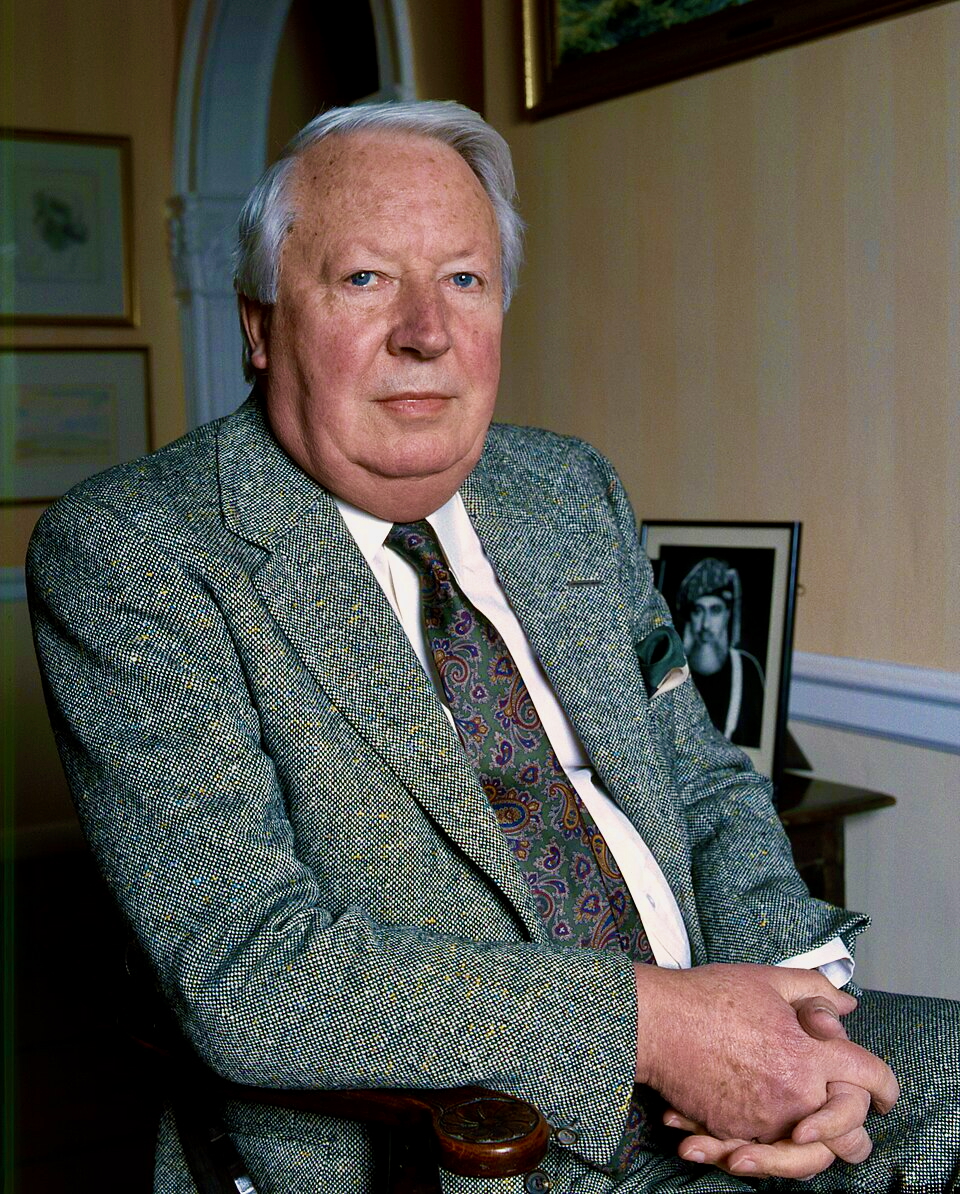
Heath photographed in his home in Salisbury, England in 1987. (Allan Warren / Wikimedia Commons / CC BY-SA 3.0)
Maitland responded by telling a Northern Ireland Office (NIO) press spokesman, one R.J.Seaman, to “seek to persuade Panorama not to include this tragic incident in the projected programme.”
The NIO, said Maitland, was responsible for dealing with the BBC request as it was the secretary of state for Northern Ireland, William Whitelaw, who had asked people in Derry to stay at home during “Operation Motorman.”
The Panorama programme went ahead on Aug. 7, 1972, without Hart’s evidence from Derry.
‘Major Effort’
Seaman’s memo of the following day told the Ministry of Defence: “After a major effort, the NIO managed to get the item removed from Monday’s programme.”
The Aug. 8th memo also stated that the Royal Scots soldier (known only by the cypher “Soldier B”) had shot Hegarty with his “General Purpose Machine-Gun” at point-blank range (between “6-9 feet”).
This flatly contradicts statements given by the military authorities in 1973, at the first inquest into Hegarty’s killing, when they claimed (supported by a map of the area) that he had been shot from further away — 25 meters — and from the opposite side of the street.
The 18-year-old soldier who fired the fatal bullets (now deceased) said in evidence to the October 1973 inquest: “I cocked the weapon and when the youths were about 25 metres away I aimed at the leading man and fired a quick burst of 3 x 7.62 rounds.”
The inquest recorded an open verdict but a later, highly critical, report from the Historical Enquiries Team (HET) led to a second inquest in 2011. After a five-day hearing, the jury found:
- There were no shouted warnings to the three cousins
- The boys were unarmed and posed no risk to the soldiers
- The soldiers failed to give medical assistance or conduct a search for alleged weapons.
Further, the HET found that the police had failed to carry out any forensic tests on the oldest boy, Thomas, who survived unscathed.
“Given,” said the HET report, “that the reason advanced for the shooting was that the youths were perceived to be a threat… this seems to have been an extraordinary omission.”
There was no attempt by the police, says the HET report, to interview the soldiers involved.
The police investigation, it said, failed to obtain clothing and forensic swabs from Thomas Hegarty, failed to take samples from the staining on the pavement, failed to recover bullet cases reportedly found at the scene, failed to obtain a timely photographic record and failed to examine the weapon used to shoot Daniel and Christopher.
Taken together, the HET said it showed the authorities unquestioningly accepted the soldier’s accounts.
‘Serious Questions’
In 2007, the British government apologised to the Hegarty family for describing Daniel as a terrorist and a Ministry of Defence document, assessing the Army’s role in Northern Ireland (“Operation Banner), also corrected its claim that the 15-year-old was armed.
Paul O’Connor, of the Pat Finucane Centre, said: “There was complicity between the MoD, police, NIO, Prime Minister’s office and the Attorney General who were all aware of the disputed circumstances of the shooting.
“The BBC itself has serious questions to answer since it self-censored an item that should have rung alarm bells. The admission that the NIO ‘managed to get the item removed’ is clear evidence of a concerted effort to hide the truth.”
Ironically, there was never any question locally of Danny Hegarty being one of the large group of young rioters in Derry at the time.
His father, Alexander, explained to the HET that Daniel had often helped him and the police in informal early morning patrols of the Creggan estate to head off trouble before it erupted.
Further, Alexander Hegarty told the HET that , two years before he was shot, Daniel had assisted police in the recovery of stolen arms.
By killing his son and giving a false account of the circumstances of the shooting, the British Army seems to have alienated the rapidly dwindling number of Derry citizens willing to give them a fair wind.
Anne Cadwallader, a former BBC journalist, is an author and advocacy caseworker at the Pat Finucane Centre in Armagh, Northern Ireland.
This article is from Declassified UK.
Please Donate to
CN’s Summer
Fund Drive!


The BBC was also crucially involved in the 1953 coup in Iran which destroyed democracy in that country and ushered in the highly repressive shah dictatorship:
“Even the BBC was used to spearhead Britain’s propaganda campaign. In fact, Auntie (a BBC nickname) agreed to broadcast the very code word that was to spark revolution. Around a decade ago the American government apologised for its role in the coup. Yet despite current concerns over oil scandals, regime change and the cost of meddling in Middle East politics – Britain has remained silent.”
“A Very British Coup” Monday 22 August 2005, BBC Radio 4 (an edition of its “Document” series).
There was a time back two or three decades ago when American media had gotten so bad and corrupt that people were watching the BBC instead. For me, that ended when Tony Blair wanted to kill many human souls so he had the BBC tell everyone that Saddam had nukes. That was obviously decades ago. I am not surprised by this story.
The BBC is state media. And it is the state media of a monarchial state that arrests thousands of its own subjects for the ‘thought crime’ of thinking differently from the King and His Government. BBC is the state media of an authoritarian regime.
Get that into your mind, and then you won’t need to read the regular stories that say ‘Gasp, the BBC was really bad this month!’
In Australia, we only ever got reports that gave credit to the British side of any and every reported clash that occured in Northern Ireland.
Our media, it’s become evident, was, and is more than willing to report the blatant propaganda that some of us now know to be designed to protect any government intent or actions that were, or are not, in the interests of the citizens that voted them into government.
This sad story, unfortunately, is only one circumstance of an uncountable number of illegal actions that are ignored by what we today call, ‘the mainstream media’, never to be trusted ever again, as are our politicians.