
In a second open letter in Berliner Zeitung, the author tells the German chancellor that diplomacy with Russia is urgent to avoid a wider war in Europe.
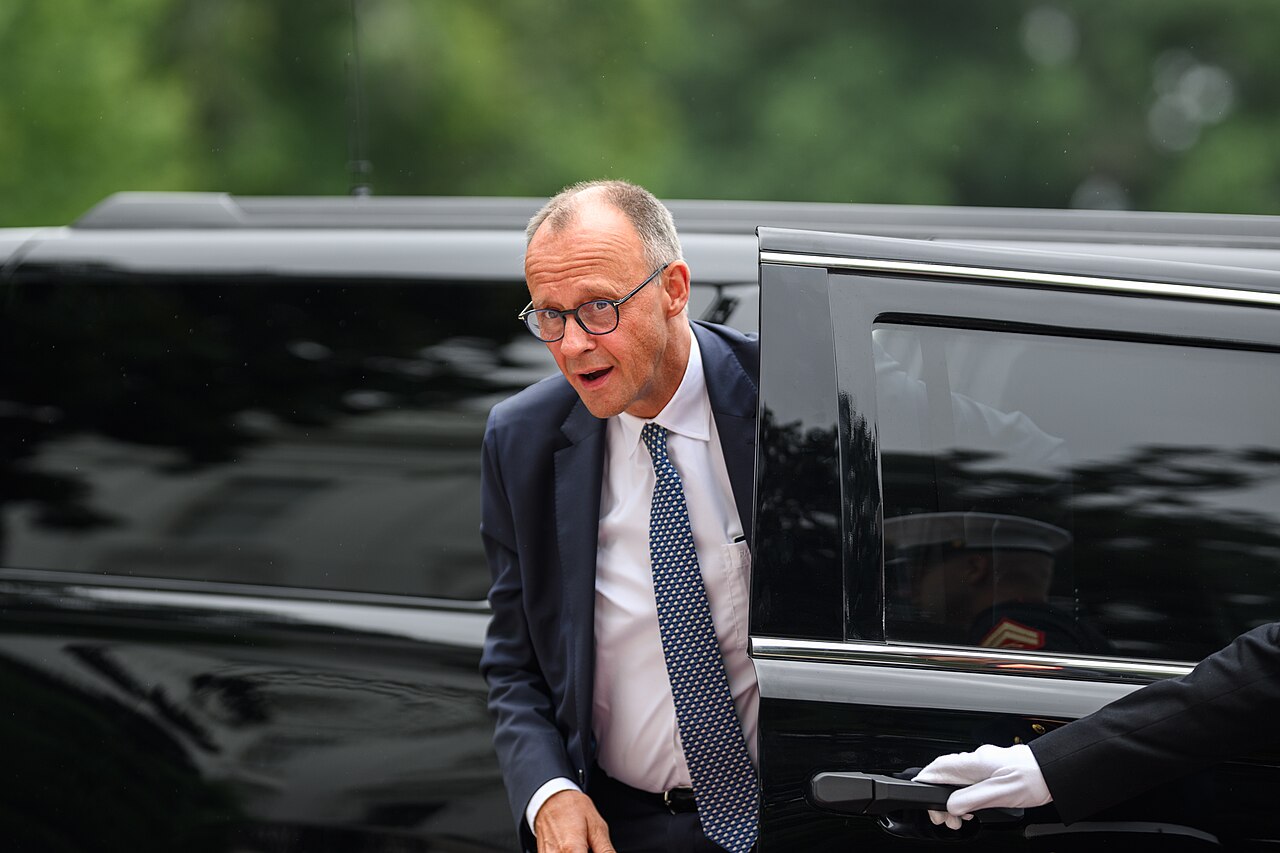
German Chancellor Friedrich Merz arriving at the White House in March. (White House/Wikimedia Commons)
By Jeffrey D. Sachs
Berliner Zeitung
 May 26, 2026
Chancellor Merz,
When I wrote an open letter to you a half year ago, I urged Germany to pursue diplomacy with Russia rather than the normalization of war. Six months later, the situation in Europe is dramatically worse. Europe and Russia are slipping into open war. And in that drift, Chancellor, your responsibility is singular. No European leader — not in Paris, not in Warsaw, not in Rome — holds the position that Germany holds, or has the power that you personally hold, to interrupt this catastrophe. Will you try for peace?
You yourself, with Prime Minister Meloni and President Macron, called in January 2026 for Europe to restart relations with Russia and described Russia as “a European country.” Yet you did not pursue diplomacy. With the future of Europe at stake, this is an extraordinary abdication of leadership. Have you, in your months as Chancellor, attempted one substantive dialogue with President Putin? Has your foreign minister attempted one substantive dialogue with Foreign Minister Lavrov? Real conversations, the kind that ended the Cold War. The answer, as far as the public record reveals, is no. Not once. And not for want of recognizing the urgency.
The past days have brought a dangerous acceleration that should focus every European mind. Both capitals are now under sustained attack: Ukrainian long-range drones have struck deep into Moscow, including civilian sites; Russian missile and drone strikes against Kyiv have greatly intensified. Ukrainian drones have crossed into the airspace of the Baltic states, raising the immediate prospect of an incident that could pull Europe directly into the war. A horrific Ukrainian strike on a boys’ school in Lugansk has further eroded what little remains of restraint. And on May 25, Foreign Minister Sergey Lavrov, acting on instructions from President Putin, formally notified the United States Secretary of State that the Russian Armed Forces are now launching „systematic and sustained strikes“ on facilities and decision-making centers in Kyiv, and the Russian Foreign Ministry has advised that the United States and other countries „ensure the evacuation of their diplomatic personnel and other citizens from the capital of Ukraine.“ That message is the prologue to a major escalation. Diplomacy is more urgent than ever.
The way to defend Ukraine is not continued slaughter, but peace on terms that are agreeable to all parties. Instead, we face escalation, with more deaths, more destruction, and the real prospect of a war that expands beyond Ukraine. By calling for ever more weapons, ever greater war-fighting capacity, and ever louder demonstrations of „resolve,“ and by signaling that Germany is preparing for war rather than working to end it, you have allowed Berlin to become an accelerant rather than a brake to a European-wide war.
Germany’s Responsibility: Six Particulars
Germany bears profound responsibility for the situation it now confronts. Before German policy can be reset toward peace, Germany’s record must be confronted honestly. I set out below six serious failures of German foreign policy vis-à-vis Russia since German reunification in 1990.
First — the 2+4 Treaty and NATO’s eastward expansion. On 12 September 1990, in Moscow, Germany signed the Treaty on the Final Settlement with Respect to Germany — the „2+4 Treaty“ — that completed German reunification. That treaty was secured because Mikhail Gorbachev was given solemn assurances, by Hans-Dietrich Genscher, by Helmut Kohl, by James Baker, and by other Western leaders, that NATO would not move eastward. The declassified record — including the now-public memoranda assembled by the National Security Archive of George Washington University — is unambiguous: those assurances were given and were clearly meant at the time to apply beyond the territory of the former GDR to Eastern Europe. These assurances were reaffirmed through 1990 and 1991.
The 2+4 Treaty restricts the placement of NATO troops in the former GDR, and recalls the principles of the Helsinki Final Act, which emphasizes that no nation’s security should come at the expense of another’s. Does any serious person believe that the Soviet Union cared about Western troops on the territory of the former GDR but was indifferent to NATO armies in Warsaw, Vilnius, or Kyiv? Of course not.
The matter of NATO enlargement was discussed in detail and explicit assurances of non-enlargement to the East were given by Germany to the Soviet leaders — and then were broken. Germany was the principal beneficiary of those assurances, which were the quid pro quo for Germany’s reunification. Yet as early as 1993, German leaders began to promote the violation of those assurances.
Second — Chancellor Merkel’s own testimony. In her memoirs, Angela Merkel writes with striking candor that she understood at the time of the 2008 Bucharest Summit that inviting Ukraine and Georgia into NATO would be tantamount to a declaration of war on Russia. She knew Russia’s red line. And yet she gave in to American pressure, accepting the compromise communiqué that Ukraine and Georgia „will become“ NATO members. That single sentence set in motion the catastrophes of 2014 and 2022. Merkel’s later candor is a gift to her successors: she has told you, plainly and in her own words, what was understood at the time. Germany should not now pretend otherwise.
Third — the betrayal of the February 21, 2014 agreement. On 21 February 2014, in Kyiv, Germany’s then–Foreign Minister Frank-Walter Steinmeier, together with his Polish and French counterparts, brokered an agreement between President Yanukovych and the opposition. The agreement provided for a return to the 2004 constitution, the formation of a national-unity government, and early presidential elections. President Putin was consulted; the agreement was confirmed. It was a serious diplomatic achievement under conditions of intense violence. Yet within twenty-four hours Yanukovych was forcibly overthrown by a violent coup. Germany did not insist on the agreement it had just guaranteed. Instead, following the U.S. lead, Germany backed the new government, as if there had been no agreement in place. That decision persuaded Moscow that Western signatures could not be trusted.
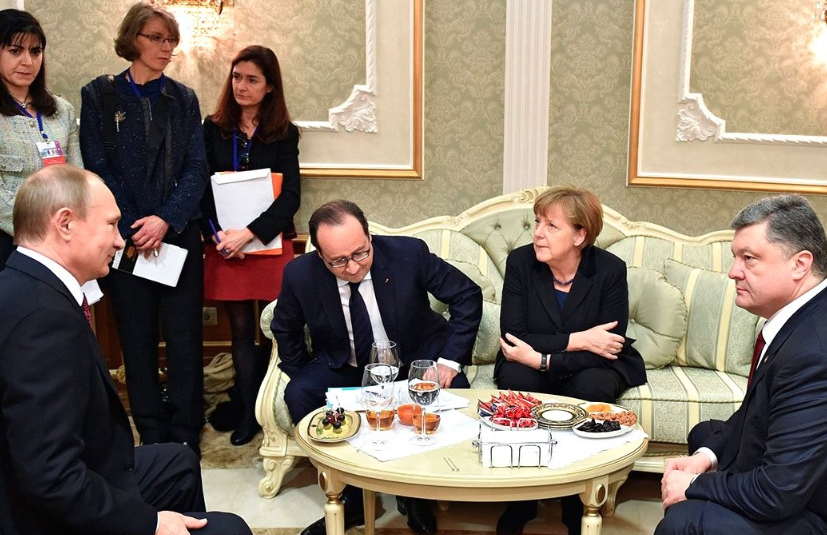
Feb. 12, 2015: Russian President Vladimir Putin, French President Francois Hollande, German Chancellor Angela Merkel, Ukrainian President Petro Poroshenko at the Normandy format talks in Minsk, Belarus. (Kremlin)
Fourth — Minsk II. In February 2015, Chancellor Merkel personally negotiated Minsk II in the Normandy Format and pledged Germany’s political backing through the Declaration of Support adopted in Minsk on 12 February 2015. For seven years, the key political provision — autonomy for the Donbas regions within a sovereign Ukraine — was never implemented by Kyiv. Germany did not press Kyiv to implement the autonomy provision it had championed — and Merkel later acknowledged that the agreement had been used as a holding action to allow Ukraine to rearm. President Hollande said the same. The guarantee, in other words, was not a guarantee at all. It was a stratagem — once again at Washington’s behest. Once again, the message to Moscow was that Western signatures cannot be trusted.
Fifth — Nord Stream. On 7 February 2022, in the East Room of the White House, President Biden announced — with then-Chancellor Olaf Scholz standing beside him — that „if Russia invades… then there will be no longer a Nord Stream 2. We will bring an end to it.“ Asked how, he replied, „I promise you, we will be able to do that.“ The pipelines were destroyed seven months later in an act of sabotage in the Baltic Sea. The available evidence — investigative reporting in the United States and Germany, the trail followed by the German federal prosecutor, and the public statements of former officials — points overwhelmingly to a joint Ukrainian-American operation. The German government has long known this. And yet Germany has permitted the public blame to fall on Russia, against the direct evidence, while an act of industrial sabotage against the German economy has gone unprosecuted and unanswered.
Sixth — the April 2022 Istanbul agreement that was within reach. Just weeks after Russia’s invasion in February 2022, Russian and Ukrainian negotiators converged in Istanbul on the terms of a peace agreement: Ukrainian neutrality outside NATO, multilateral security guarantees, agreed troop limits, and the political resolution of the Donbas and Crimea questions over time. The agreement was within days of signature. Former Israeli Prime Minister Naftali Bennett, one of the mediators, has confirmed publicly that the deal was close and that the West — the United States and the United Kingdom in particular — moved to block it. Prime Minister Boris Johnson’s mission to Kyiv in April 2022 to instruct Ukraine not to sign is a matter of public record. Hundreds of thousands of Ukrainian and Russian lives, and the wider European order, have paid the price for that US–UK intervention. Germany has not raised its voice on this — even though Germany, more than any other European state has borne the economic consequences.
The Second Catastrophe: Germany’s Economic Self-Destruction
Your first concern must be peace. Yesterday’s message from Moscow tells us how late the hour is. But there is a second catastrophe unfolding alongside the first: the willful destruction of the German economy, with Berlin as both author and victim.
Germany’s industrial economy was built on trade with Russia. The destruction of Nord Stream and the subsequent severance of Germany’s trade relations with Russia have left Germany buying natural gas from the United States at prices several times higher than the Russian pipeline gas it replaced. This is industrial suicide. Germany’s chemical sector, its steel sector, its glass industry, its energy-intensive manufacturers — the very foundations of the Mittelstand — are losing international competitiveness day by day. Skilled jobs are draining out of the German economy. And the German taxpayer and the German consumer are making a transfer of national wealth from Germany to American gas producers at a scale unprecedented in postwar Europe.
On top of this, the German government is now pledging an enormous defence build-up — hundreds of billions of euros over the coming decade — to arm for a war that diplomacy can easily prevent. This is a profound misallocation of national resources. The fundamental challenge facing Germany in this decade is competitiveness in the digital age. Every euro spent on tanks, missiles, and artillery shells is a euro not spent on Germany’s AI capacity, its chip-design and chip-fabrication capability, its energy infrastructure, and the high-speed digital networks that Germany needs to remain a top global economy.
The hard reality, Mr. Chancellor, is that there is no security to be bought with these arms that diplomacy cannot buy at a tiny fraction of the cost, and there is no prosperity to be had without the digital and energy investments that this arms buildup will crowd out.
My Appeal
Chancellor Merz, more than any other European leader, the question of whether Europe descends into general war, or returns to negotiation, and to economic sanity, rests with you. The hour is very late. Yesterday’s formal message from Moscow to Washington says so explicitly. Please open a dialogue with President Putin. Please send your foreign minister to Moscow or invite Russia’s Foreign Minister to Berlin. Please reopen the OSCE channels that Germany has allowed to atrophy. Please tell Kyiv to cease its strikes on civilian targets.
Most importantly, please tell the German public the truth: that a negotiated peace based on Ukrainian neutrality is the realistic path out of catastrophe, and that restoring a normal economic relationship with Russia is the realistic path out of Germany’s industrial decline.
The terms of an acceptable agreement that Germany could propose are clear. The fighting would stop on an armistice line. All sides would renounce any future resort to violence on the question of borders. Ukraine would restore its neutrality, and NATO would permanently renounce further eastward enlargement.
Europe and Russia would restore economic relations and would stop the warmongering. The OSCE would once again become the central forum for European security, with the fundamental precept that European security is indivisible, not based on military blocs dividing Europe. Alongside this peace, Germany would redirect its national resources toward the digital, AI, semiconductor, and energy investments that Germany’s economic future demands.
History will record what you do in the weeks ahead, and what you fail to do. So will the German public. So will the peoples of Russia, Ukraine, and Europe generally. It’s time for diplomacy, Mr. Chancellor. The choice is yours to make.
Respectfully,
Jeffrey D. Sachs
University Professor of Columbia University
Jeffrey D. Sachs is a University Professor and Director of the Center for Sustainable Development at Columbia University, where he directed The Earth Institute from 2002 until 2016. He is also President of the U.N. Sustainable Development Solutions Network and a commissioner of the U.N. Broadband Commission for Development. He has been advisor to three United Nations secretaries-general, and currently serves as an SDG Advocate under Secretary-General Antonio Guterres. Sachs is the author, most recently, of A New Foreign Policy: Beyond American Exceptionalism (2020). Other books include: Building the New American Economy: Smart, Fair, and Sustainable (2017) and The Age of Sustainable Development (2015) with Ban Ki-moon.
Please Donate to the
Spring Fund Drive!


… fear- and warmongering find no end, alas.
common sense à la sachs is hard to come by!
the monstrous mongers and the profiteers
CON_stantly claim that “peace does pay!”
and indeed, they happily keep raking in billion$,
laughing most heartily all the way to their bank$.
as the german car industry is no longer competitive and
other industries are weakened, due, i.a., to high energy costs,
our arms makers gladly move in – as a last[!] resort – to keep
employment figures from plummeting.
and germany from collapsing.
to rise again from the ruins of yet another lost war?
what ultra-sorry performances!
merz and schmerz are one and the same pain.
if more than half of germany’s population is against war,
abt 40 million should take to the streets. where are they?
the claim must, of course, read: “peace does NOT pay!”
There are two ways of looking at J. Sachs’ letter.
One is from the standpoint of what should be done in a rational world, based on the facts on the ground, the actual historical record, and evidence from “diplomatic relations”; and in that respect, it should be plain that JS advice is the only way forward.
Yet, the other side is what is realistic Germany will actually do, and more crucially, WHY the country has failed to do differently so far, here including what Sachs describes as “failures” in German diplomacy, which should be better indicted as catastrophic, yet entirely intentional political blunders.
The bottom line is that Germany, like other Western countries, desperately need to agitate the specter of Russian “security threats” to justify its own massive military build up, which had been actually planned since way before Ukraine ever became an issue in the international stage.
That’s what most analysts keep missing about Germany. The country’s history in the post-WWII aftermath has been largely distorted. German leadership has never renounced to go back to being a strong military power (take a look, just as example, at the transparent statements released during security conferences by certain German defense officials and industrialists in the early 2000s), but, until recently, they had historical and internal political constraints that would prevent them from doing so.
Russian invasion of Ukraine and the ensuing war, that Germany has actually contributed to provoking and alimenting with the deliberate undermining of the Minsk agreements and subsequent peace efforts, is precisely what the German elites needed to finally justify a return to a policy of military might. Berlin knows way too well that Russia doesn’t have any security beef with Germany, and, absent any offensive action on the other side, Moscow does not represent a military threat at all to Germany – or Western Europe for that matter. But not only cannot the German establiment admit it, they need to manipulate the public into thinking exactly the opposite, to serve and fulfill pre-ordained political goals of grand military might and imperialism.
That is exactly why Germany will not follow a path of negotiated peace and normalization with Russia. To the disatrous damage of all of us.
After so many times that Germany had taken advantage of the Russians, why should they believe them now? Why shpuld they believe this time is for real and they are not buying time again?
The EU is not only a marginal global player, they are incompetent on their on soil as they allowed those two wars and yet no one’s trying to stop it.
Through NATO the US started the war and the tRump disengaged and left the rest of NATO holding the stinky bag.
Germany has forgotten. Germany has not learned her lesson. Last time it was destroyed and occupied completely. It was supposed to be the end of Germany Militaristic insanely flaw character . Next time germany will be erased for good, germany will never rise again, that is, if anything of europe survived at all …
One correction. It was a girl’s school that was struck in Luhansk. In any case, western imperialists refuse to accept their days of controlling the whole world are done. That is what sticks in their craw. When Putin kicked out the Wall Street looters having a field day under Yeltzin, they were incensed. How dare he demand sovereignty for Russia when in their perceptions, Russia was defeated when the USSR fell apart? They consider it their territory. They would rather risk nuclear annihilation for humanity than accept the new global paradigm. These idiots need to removed from power ASAP. They have forfeited their right to rule anywhere ever again.
“… however, we have every reason to assume that the next time drones are launched to kill Russian children, they may well originate from NATO territory. Do not be surprised by our harsh and merciless response—you are currently pleading for it! ” Dmitry Polyansky, Russia’s Representative to the OSCE. May 28, 2026.
Polyansky closed his statement at the OSCE with a reference to this piece by Dr Sachs.
” This gesture of despair by Jeffrey Sachs and his attempt to reach the German elite demonstrate that there are those who still believe in the OSCE—presumably because they do not know the details of what Western states have actually turned this organization into. Today, no betting house would accept wagers on the OSCE’s future if they possessed the facts, even if the payout were a million to one. Therefore, those who truly wish to preserve peace in Europe must act not through the OSCE, but in spite of it. And you, colleagues, prove to us in this chamber every single week that this is the only correct path.
Thank you for the attention. ”
-ibid
hxxps://osce.mid.ru/en/official/news/dmitry_polyanskiy_on_the_ongoing_attempts_by_certain_osce_participating_states_to_undermine_efforts_28052026/
Thanks, Prof. Sachs. Europe needs people with your clarity of mind.
Actually, the whole world does – very badly. Particularly in the West.
The irrationality of European leaders in their behaviour toward Russia is bordering on insanity. How else can you explain their current actions which are manifested most particularly in the case of Germany. The road to perdition for Europe would be the failure to recognise the common sense advise of Jeffrey Sachs which is clear in his letter to Friedrich Merz. Not doing so would confirm that a diagnosis of insanity is the only possible conclusion that can be ascribed to their current actions.
Merz is gewoon een Black Rock rat , die Europa verder in de oorlog wil duwen , en dit in het voordeel van de militaire industrie in de VS
“If Prince Vladimir had decided in 988 in the Chersonese in Crimea already! to convert to Roman Catholicism rather than to Orthodoxy, the whole history of Europe would have been changed, as no one, either in the West or in the East, would have questioned that Russia was part of Europe. Courted both by Rome, which had just converted the Poles and Hungarians and the Byzantium, ……”
Excerpt from ‘CREATING RUSSOPHOBIA’, p 104, by Guy Mettan. Can highly recommend to better understand todays Russophobia.
So well written,thanks Jeffrey
Ditto. It would be hard to say it better or more urgently.
If the Chancellor doesn’t respond favourably to this highly reasonable entreaty then the world will know that malicious unreasonable intent is lurking in the actions of this Chancellor.
And not only the Chancellor , but every leader of the EU and Britain.
In an age of MAD the path these EU leaders are taking is complete insanity.
Merz will simply delete this rather than read it. The hideous truth. The fox guarding the hen house scenario.
Superb article by the way! But the foxes are not interested.
I think Sach’s worthy urgings of Merz is an exercise of blowing into the wind. “While he (Merz)”has not directly profited from arms companies himself, the massive increases in defense spending and procurement contracts pushed under his administration have led to record profits and surging stock prices for German defense contractors like Rheinmetall. This has fueled political criticism that his military policies primarily benefit shareholders of the defense industry.” (Codepink)”Then there is this. BlackRock is deeply involved in the defense sector, primarily as the world’s largest institutional investor rather than as a direct weapons manufacturer. “(Codepink)”The firm holds massive equity stakes in major defense contractors like Lockheed Martin, Northrop Grumman, Boeing, Raytheon (RTX), and General Dynamics” Whom did Merz once work for? “Chairman of the Supervisory Board: For the German branch of the American investment firm BlackRock from 2016 to 2020.Corporate Lawyer: Retaining a position as senior counsel at the international law firm Mayer Brown, where he worked for 16 years.”(DW.com) Can a tiger change its stripes?; or someone who was once a fervid anti-communist possess a scintilla of a motive to talk diplomacy with Russia’s Putin?
Merkel’s behaviour has not been explained. She surely understood Russia’s position and wanted peace. Why support the known corruption of Ukraine against a reasonable Russia? Look at the results.
So, go figure. A ‘corrupt’ state such as Ukraine gets what they want, and Merkle lives very well afterward. You do the math. Merkle is not sitting by the side of the road with a sign begging for food. Why support the known corruption of Ukraine? I’d say a Swiss bank account would be the answer, except now that the Swiss are EU government friendly and not so private anymore, the account is probably not in a Swiss bank.
Another European war is inevitable.
The British insist there will never be peace with Russia.
Germany is not the problem.
“Germany is not the problem” – You must have eyes & ears fully disengaged to make a statement like that.
Both the UK & Germany are guilty of being willing partners of the Evil that is the uSA war mongers.
The uSA is the Head of the snake causing conflicts planet wide. They must be made to suffer!
You are blind and mad, Russia is not our enemy. Our enemy is in the dishonest and insane oligarchy that lead the USA EU UK.
This criminal oligarchy is pushing to war the entire Europe. Open your eyes and do not follow the shit propaganda.
I hope Merz reads and heads this, but it really seems like is no more than a puppet figurehead for the US Empire, not an actual leader.
Brilliant and erudite as always. Exactly correct and backed up by Professor Sachs’ detained investigation as well as being on the scene for many of these moments, including the day after the Maidan coup at the request of the Ukrainian government. His well documented descriptions are not hearsay or second hand.
I can no longer fathom or excuse the vacuousness of Europe’s political class. At every possible juncture over the last four years they have resolutely followed the path for more war. The West’s “Project Ukraine,” set in motion by Obama and for which Biden, Blinken and Nuland were on point, is a long-term neocon fever dream fueled and supported by the Military Industrial complex and fossil fuel industries. Of course, everything that neocons touch turns to mud but then chaos is not a fault in their plans but their modus operandi for gathering more wealth and power. Project Ukraine is being fought to the last Ukrainian for the sake of Western neocon dreams by Zelenskii who was elected on a peace platform, and supported by Europe’s political elite. To my eyes, it is impossible that these decrepit, soulless leaders are not being paid off to pursue the goal of bringing down and breaking up Russia at the cost of the Ukrainian nation and even their own. Of course, it is not working out as they had expected. “Duh, again.” In any case, they are not noble nor innocent bystanders. These Western leaders are monsters.
As good as the Sachs column, mgr. Sachs historical record is unimpeachable and probative. Pro-war arguments ignore them completely, saying only “friend of Putin.” A gratifying feature of both Chat and Claude AI is that they come in with the Biden/Dem bias, but when you challenge them point by point, they begrudgingly come to their senses.